

Introduction
Artificial Intelligence has moved from promise to practice in education. As we navigate 2025, AI is no longer an emerging trend—it has become the operating layer for education and workforce development. The global AI in education market is expected to reach $32.27 billion by 2030, growing at an astounding CAGR of 31.2%. This transformation is reshaping how students learn, how educators teach, and how institutions measure success.
According to recent research, 60% of educators now incorporate AI into everyday instruction, and nearly all district leaders (97%) recognize the potential benefits of AI's impact on education. This comprehensive guide explores the AI technologies and innovations that are defining EdTech in 2025.
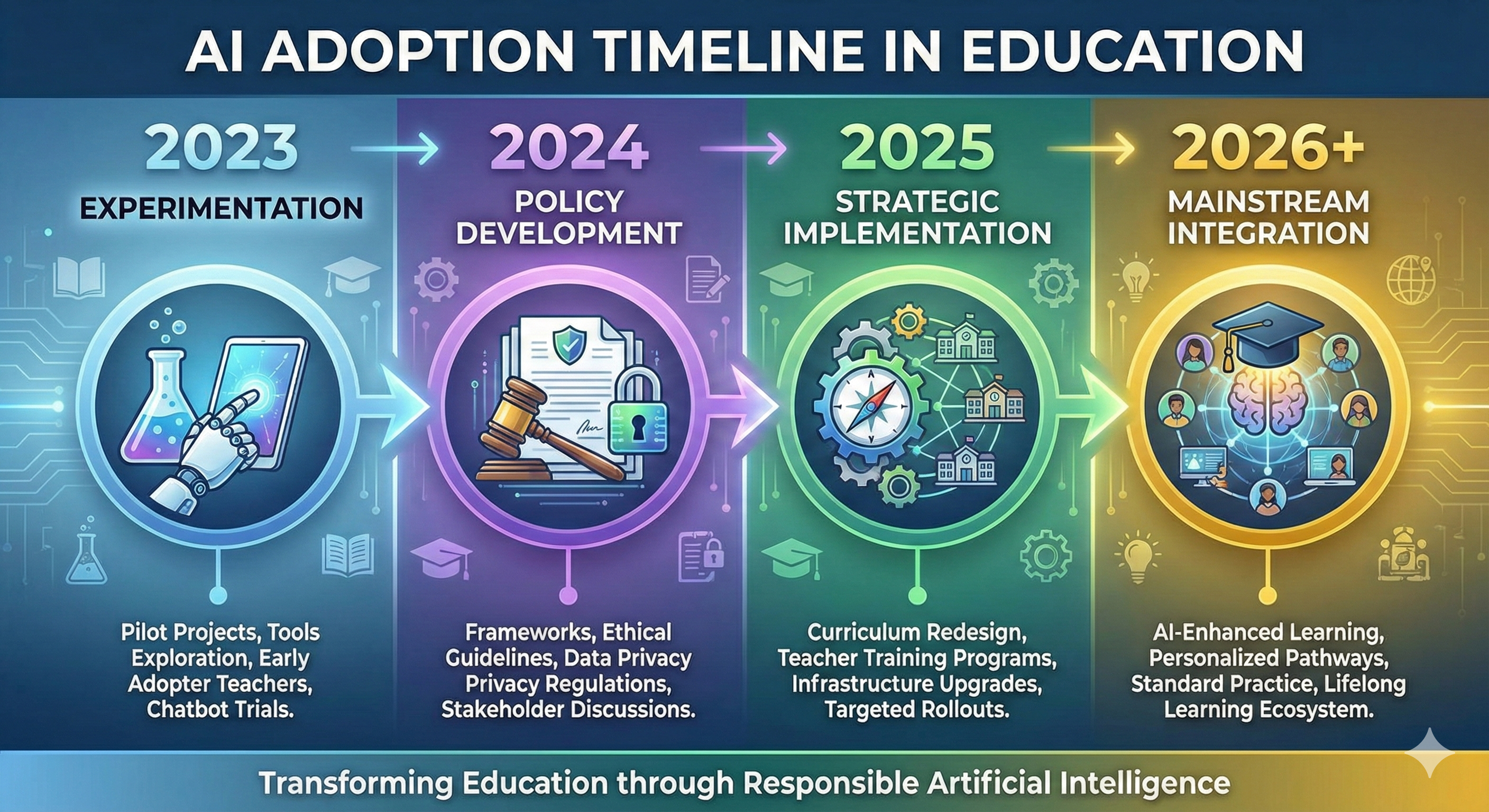
1. Generative AI: From Experimentation to Strategic Implementation
The rush to implement AI over the past two years has evolved into more thoughtful, strategic approaches. Companies are now focusing on where AI can genuinely enhance learning experiences rather than simply adding AI features to stay competitive. As the OECD Digital Education Outlook 2026 emphasizes, GenAI should be used selectively and purposefully for pedagogical reasons to enrich learning—not to replace cognitive effort.
Key Applications of GenAI in Education
- Content Creation: AI tools that help educators create lesson plans, assessments, and learning materials faster
- Question Generation: Automated creation of quizzes and practice exercises tailored to curriculum
- Real-Time Translation: Breaking language barriers for multilingual learners
- Administrative Automation: Reducing teacher workload through automated grading and documentation
- Course Assistant Bots: AI assistants that help address learner questions and facilitate course completion
AI Adoption Statistics 2025 65% of higher ed students believe they know more about AI than their instructors 45% of instructors report positive perceptions of generative AI 55% of recent graduates say their programs didn't prepare them to use AI tools |
2. AI-Powered Personalized Learning
AI's greatest potential lies in personalization—tailoring learning to each student's unique needs, pace, and preferences. Using machine learning and natural language processing, AI-powered platforms can assess students' strengths, weaknesses, and learning preferences with unprecedented accuracy.
How AI Personalization Works
- Learning Profile Analysis: AI systems analyze historical performance, interaction patterns, and preferences to build comprehensive learner profiles
- Adaptive Content Delivery: Platforms automatically adjust lesson difficulty and content type based on real-time performance
- Predictive Intervention: AI identifies struggling learners before they fall behind, enabling proactive support
- Personalized Feedback: Real-time, context-aware feedback that helps learners understand their mistakes and improve
Leading AI Learning Platforms
Platform | Key AI Feature | Target Audience |
Squirrel AI | Adaptive learning paths | K-12 Students |
Microsoft Reading Coach | Literacy development AI | Elementary learners |
Duolingo | Personalized hints & feedback | Language learners |
Cengage Student Assistant | GenAI-powered tutoring | Higher education |
3. Intelligent Tutoring Systems (ITS)
GenAI is transforming traditional Intelligent Tutoring Systems from rigidly scripted digital tutors into dynamic pedagogical agents capable of questioning, nudging, and shifting strategies through natural, dialogue-based interactions. Research demonstrates that even inexperienced tutors can enhance the quality of their tutoring and improve student learning outcomes by using educational GenAI tools.
Capabilities of Modern ITS
- Natural Language Interaction: Students can ask questions in conversational language and receive contextual responses
- Socratic Questioning: AI tutors guide learning through strategic questioning rather than direct answers
- Multi-Modal Support: Combining text, voice, images, and interactive elements for comprehensive learning
- Emotional Intelligence: Detecting learner frustration and adapting tone and approach accordingly

4. Learning Analytics and Predictive AI
A 2024 forecast predicts that 70% of EdTech platforms will integrate advanced analytics by 2026. Learning analytics harnesses AI to analyze student data—engagement patterns, performance metrics, and behavioral patterns—offering actionable insights to personalize teaching and predict challenges.
Types of AI-Powered Analytics
- Descriptive Analytics: Understanding what happened through historical data analysis
- Diagnostic Analytics: Identifying why certain outcomes occurred
- Predictive Analytics: Forecasting future performance and identifying at-risk students
- Prescriptive Analytics: Recommending specific interventions and learning paths
5. Extended Reality (XR): VR, AR, and Mixed Reality
Extended Reality technologies are gaining significant traction in education. As equipment costs decrease, VR and AR are expected to become mainstream classroom tools. VR in education is predicted to become a $700 million industry by 2025, with applications ranging from virtual field trips to complex surgical simulations.
XR Applications in Education
- Virtual Labs: Students can conduct experiments without physical constraints or safety concerns
- Immersive History: Walk through historical events and locations in first-person perspective
- Medical Training: Practice procedures and surgeries in realistic virtual environments
- Soft Skills Training: Simulate workplace scenarios for professional development
- AR Overlays: Interactive digital content layered on physical textbooks and materials
6. Cybersecurity and Data Privacy
As AI collects more student data, cybersecurity has become paramount. Schools have witnessed a rise in website accessibility lawsuits and data breaches, with over 4,000 ADA web accessibility lawsuits filed in 2024 alone. EdTech companies are investing heavily in robust cybersecurity measures including encryption, multi-factor authentication, and advanced threat detection.
Essential Security Considerations
- FERPA/COPPA Compliance: Ensuring student data protection aligns with federal regulations
- SOC 2 Certification: Third-party verification of security practices
- Data Minimization: Collecting only necessary information
- Transparent AI: Clear communication about how AI uses student data
- Regular Audits: Continuous monitoring and improvement of security protocols
7. AI Literacy and Educator Professional Development
A 2024 survey found that 68% of teachers seek more training on AI tools. UNESCO has published AI competency frameworks for both students and teachers, guiding countries in supporting stakeholders to understand AI's potential and risks. The focus is shifting from one-off workshops to continuous, tailored professional learning.
Key Areas for AI Professional Development
- AI Fundamentals: Understanding how AI works and its educational applications
- Ethical Considerations: Addressing bias, privacy, and responsible use
- Practical Integration: Using AI tools effectively in instruction
- Data Interpretation: Making sense of AI-generated insights
- Student Guidance: Teaching students to use AI responsibly and effectively
8. The Future: LLM-Agnostic Architecture
Competition between AI models continues to intensify, with tech leaders launching new models at an unprecedented pace. For EdTech providers, the real advantage comes from being LLM-agnostic—building flexible systems that can work with any model. This approach ensures learners and educators always get the best experience as technology evolves.
Educational advantage is increasingly defined less by access to models and more by ownership of domain-specific intelligence. Organizations that invest in building specialized educational AI capabilities will have significant competitive advantages as the market matures.
Conclusion: The Human-AI Partnership in Education
The message from research and practice is clear: AI in education should amplify human teaching, not replace it. As the OECD emphasizes, learning and teaching should primarily aim to develop valued human knowledge and skills such as independent thinking and foundational skills—with GenAI serving as a tool to enrich this process.
The organizations that will lead in 2025 and beyond are those that move beyond experimentation and commit to building AI that is trusted, aligned with pedagogy, and measured by educational outcomes. Technology is transforming education, but the core mission remains unchanged: helping learners achieve their potential.
Key Takeaways:
|