The pressure on Learning & Development teams has never been higher. Organizations want more courses, faster turnaround times, broader topic coverage, and learning experiences that are personalized for every learner, all without inflating budgets. For most L&D leaders, the math simply doesn't work with traditional content production methods.
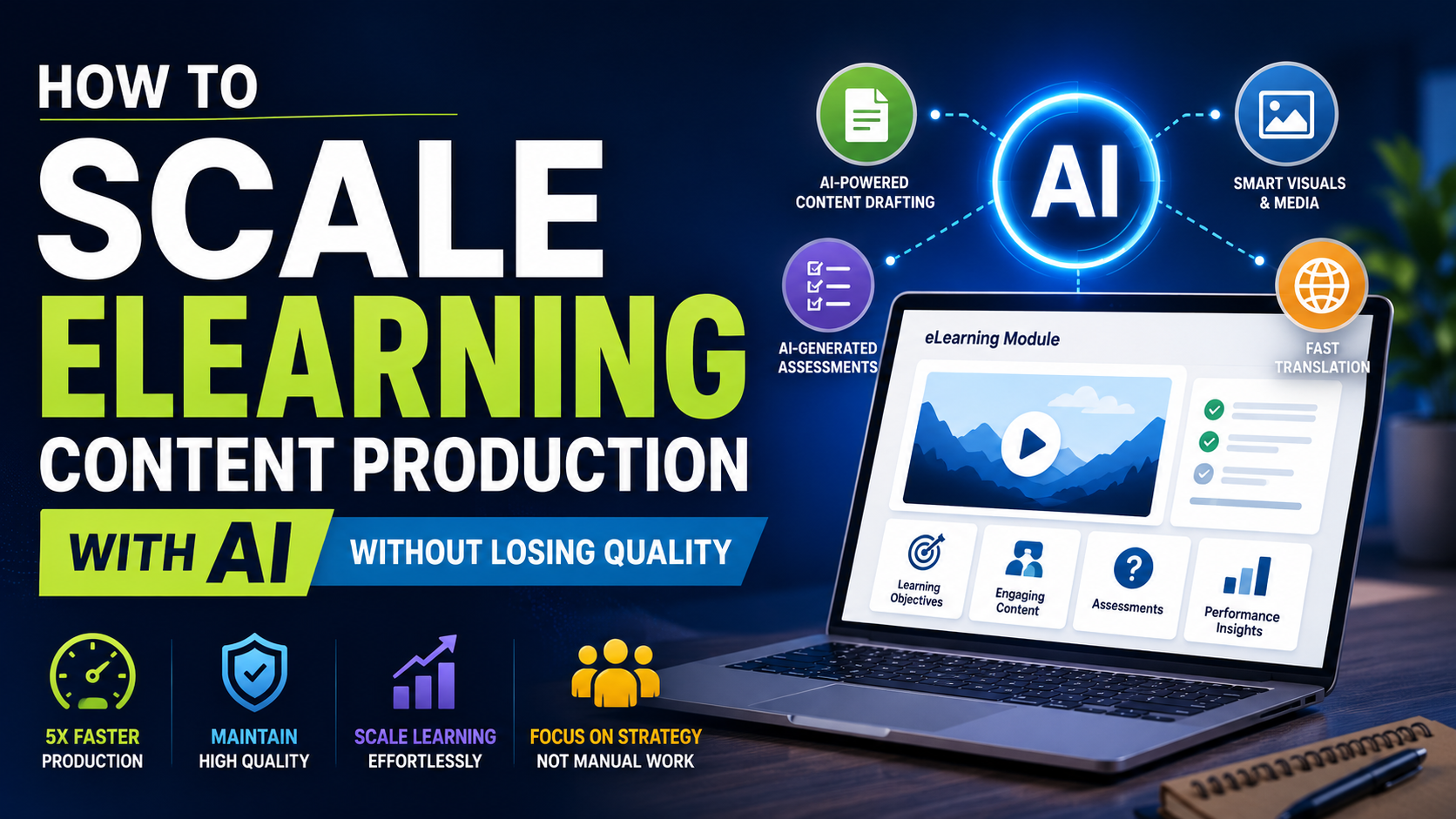
This is exactly where AI eLearning content production has emerged as the most significant shift the industry has seen in over a decade. Done right, AI can compress weeks of work into days, multiply your output by 5x or more, and free your instructional designers to focus on the strategic, high-value parts of course design. Done poorly, it produces generic, hallucinated, or shallow content that damages learner trust and brand reputation.
This guide is for L&D heads, instructional design managers, training directors, and course development leads who want a clear, practical roadmap for scaling content with AI without losing the quality, accuracy, and pedagogical depth that make learning actually work.
Why Traditional eLearning Production Can No Longer Keep Up
A single 60-minute eLearning module traditionally takes anywhere between 80 to 220 hours of production time, depending on complexity, interactivity, and media. That includes subject matter expert (SME) interviews, scripting, storyboarding, visual design, voiceover, development on authoring tools, QA, and revisions.
For an organization producing even 30 hours of finished learning per year, that's a full team working at capacity. Now consider what most modern L&D functions are being asked to deliver:
- Annual compliance refreshes across multiple jurisdictions
- Role-based onboarding for dozens of job families
- Frequent product and process update training
- Leadership development pathways
- Localization into 5–15 languages
- Microlearning libraries for just-in-time performance support
The demand curve has gone vertical. The supply curve, constrained by human production capacity, has not. This gap is precisely what AI is built to close and it's why AI in L&D has shifted from experimental to essential within the span of two years.
What "AI eLearning Content Production" Actually Means
There's a lot of confusion in the market about what AI can and cannot do in course development. Let's draw clear lines.
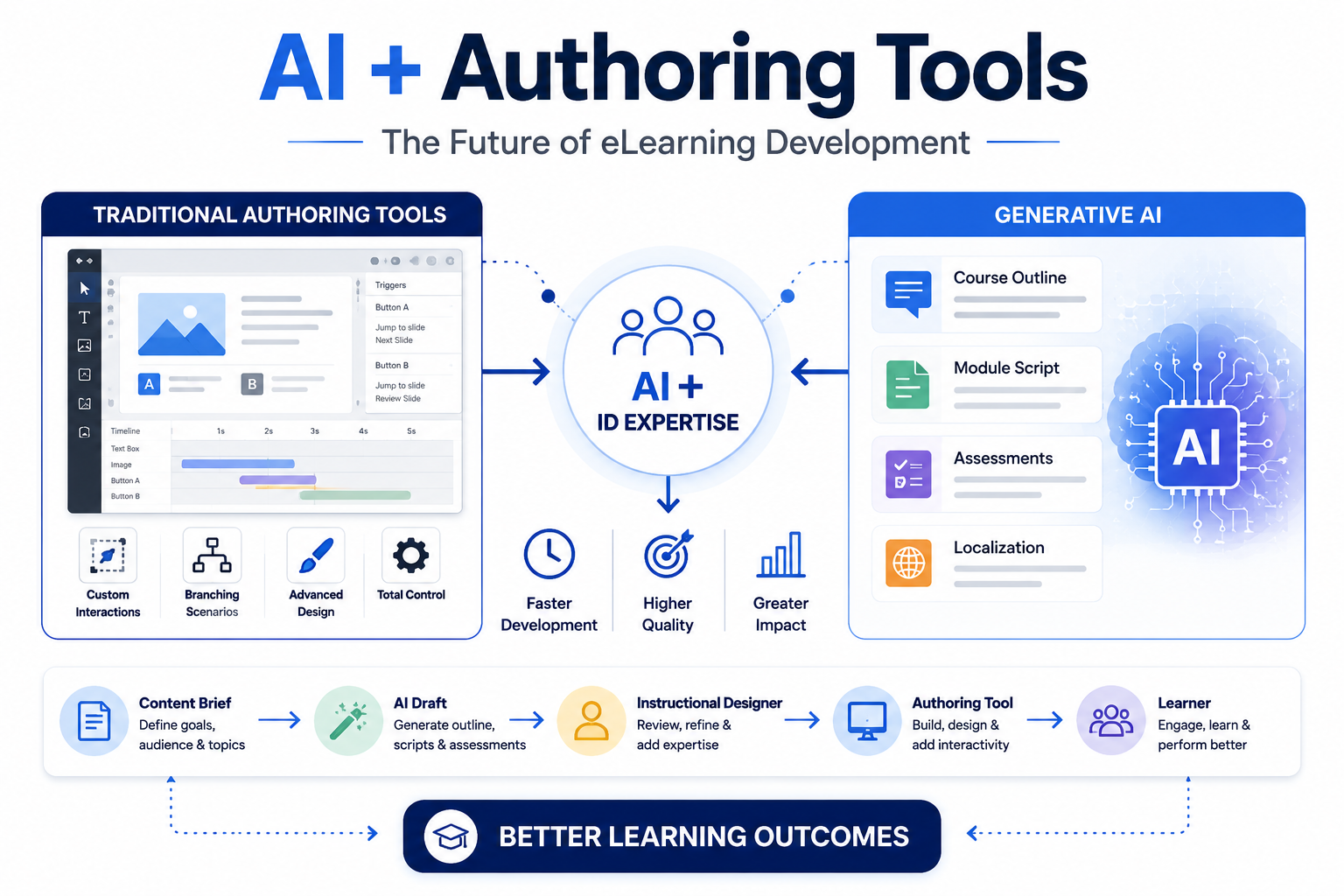
AI eLearning content production refers to the use of generative AI, large language models, computer vision, and speech AI to assist or automate parts of the instructional design and course development workflow. This includes content drafting, learning objective generation, scenario writing, assessment creation, visual asset generation, voiceover synthesis, translation, and accessibility transcription.
What AI is not is a replacement for instructional design expertise. The model doesn't know your learners, your business context, your regulatory environment, or your brand voice unless you teach it. The teams getting outsized results from AI are not the ones who type "create a course on cybersecurity" and accept whatever comes back. They're the ones who have built structured workflows where AI handles the high-volume, pattern-based work and humans handle judgment, strategy, and quality control.
The Five Stages of AI-Augmented Content Production
To scale without losing quality, you need a production model that maps each stage of course development to the right combination of human and machine effort. Here's the framework that works.
Stage 1: Pre-Production and Needs Analysis
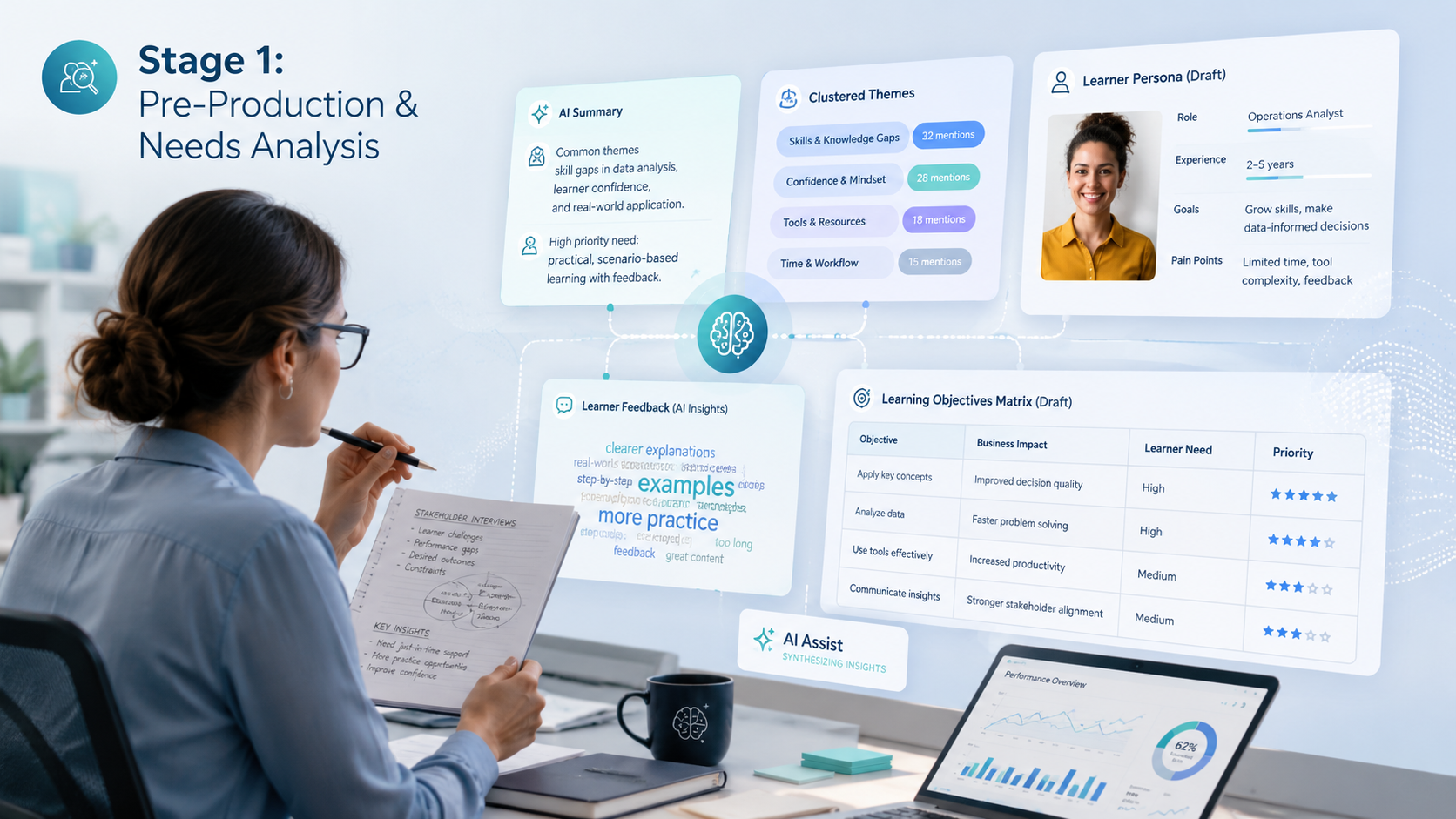
This stage stays human-led. Learning needs analysis, stakeholder interviews, audience research, and performance gap identification require contextual judgment that AI cannot replicate. However, AI can accelerate the synthesis work, summarizing interview transcripts, clustering learner feedback themes, and surfacing patterns from existing performance data.
A good practice here is to use AI to draft a learner persona document or a learning objectives matrix based on your inputs, then have your instructional designer refine it. The draft saves hours; the refinement ensures it reflects reality.
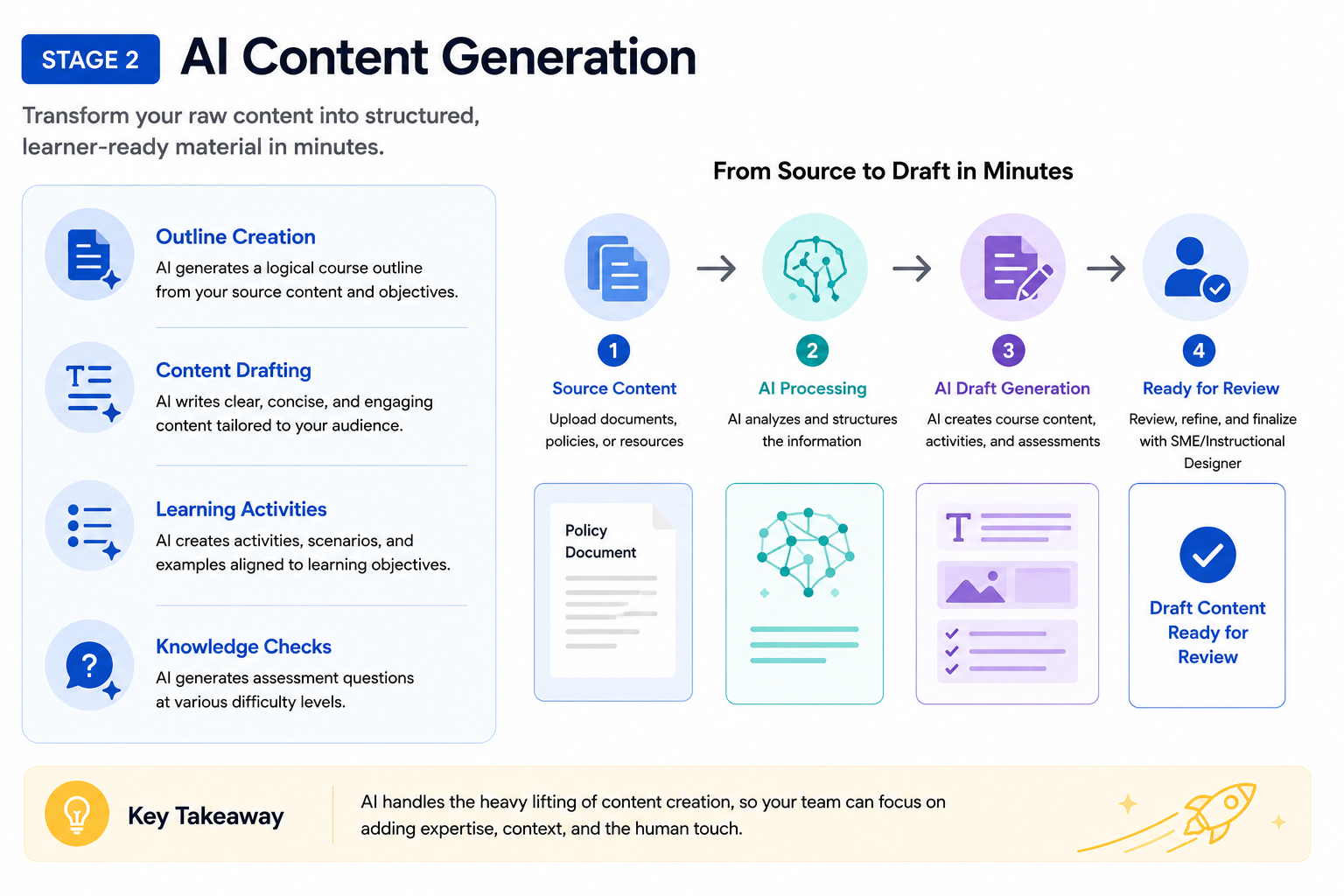
Stage 2: Content Drafting and Scripting
This is where AI delivers its biggest productivity gains. A well-prompted model can generate a complete first-draft script for a 20-minute module in under an hour, compared to the 8–12 hours a human writer would take from scratch.
The non-negotiable here is grounding. Never let the model generate from open-ended prompts on technical, regulatory, or proprietary content. Feed it your source material, SME documents, policy PDFs, technical manuals, prior course content and instruct it to draft strictly from those sources with citations. This single discipline eliminates the vast majority of hallucination risk.
A practical workflow that works well: take your approved source material, chunk it by learning objective, prompt the AI to generate a script for each chunk in your chosen instructional format (story, scenario, explainer, case study), then have an instructional designer review and refine. Output increases roughly 4–6x with no measurable quality loss.
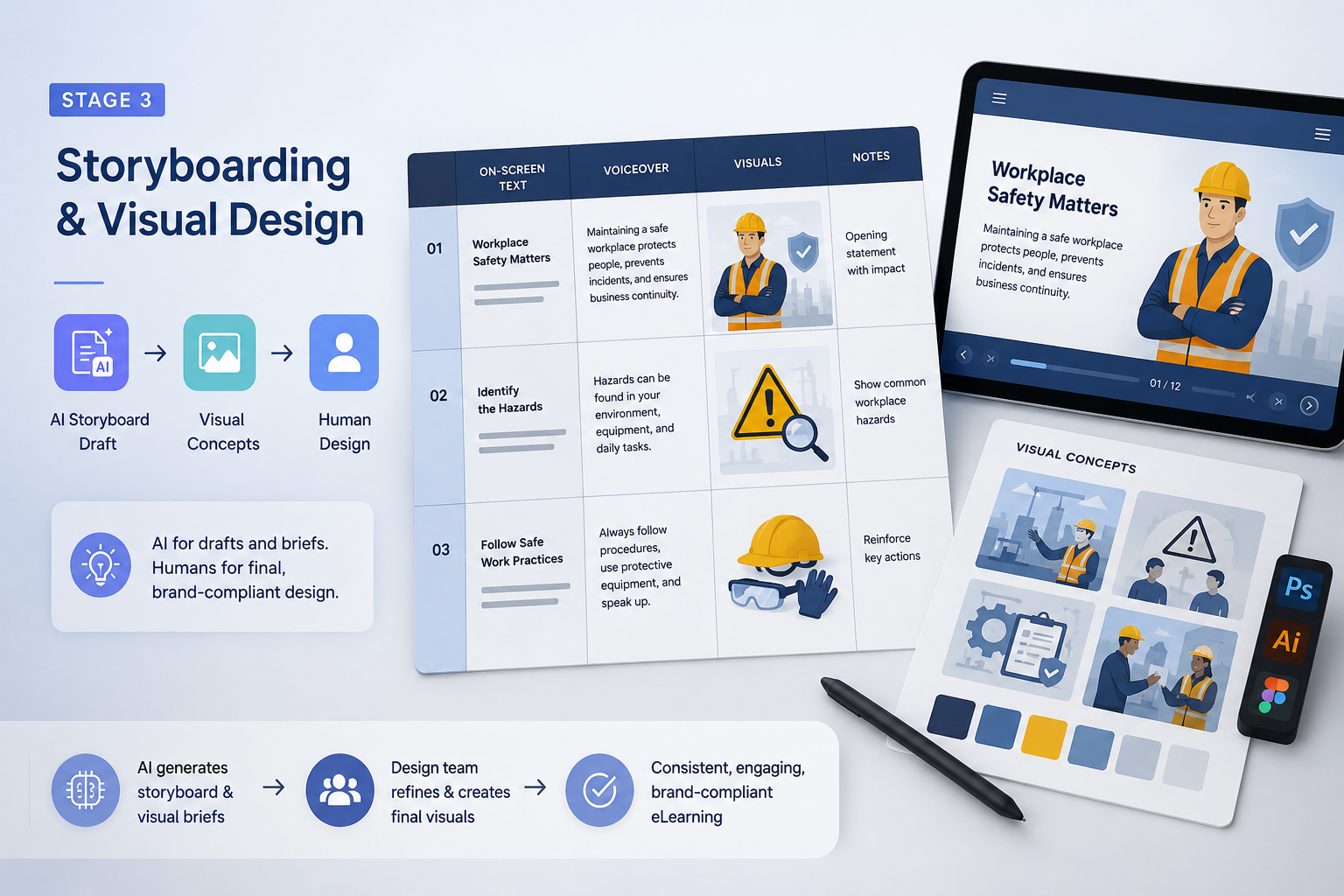
Stage 3: Storyboarding and Visual Design
AI can generate storyboard drafts in structured templates, four-column scripts with visual descriptions, on-screen text, voiceover, and developer notes. It can also generate placeholder visuals, icons, and illustration concepts using image generation tools.
For finished visual design, current AI tools are good for ideation and rough comps but not yet reliable for final brand-compliant production. The most efficient model is to use AI for the storyboard text and visual briefs, then route final design to your visual team or a templated authoring tool.
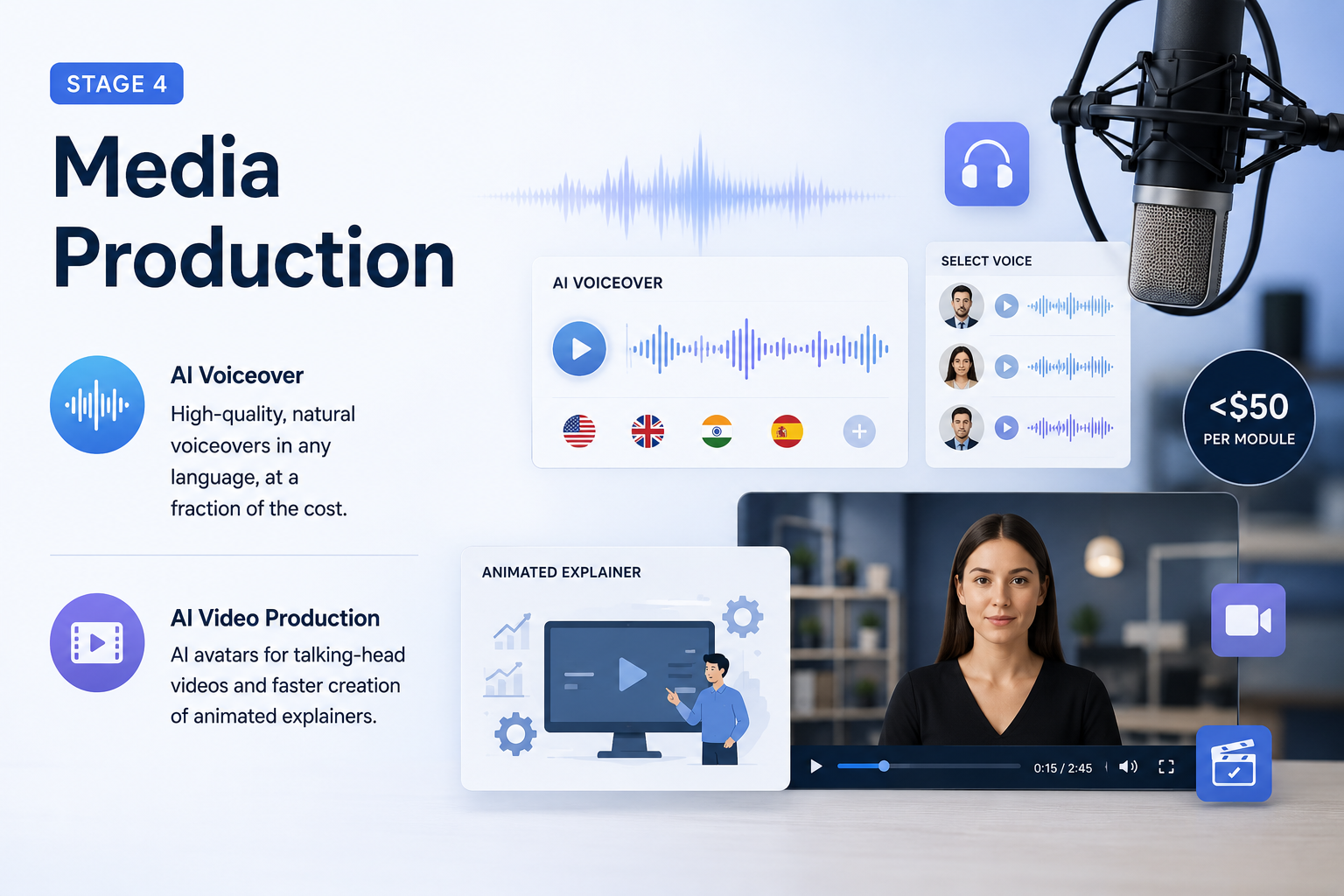
Stage 4: Media Production
Voiceover is the single biggest cost-saving opportunity in AI media production. Modern AI voice synthesis is now indistinguishable from human voiceover for most use cases, and it costs a fraction of studio recording. A 30-minute module that would have required a $1,500 voiceover session can now be produced for under $50 with multiple voice options, instant revisions, and any language.
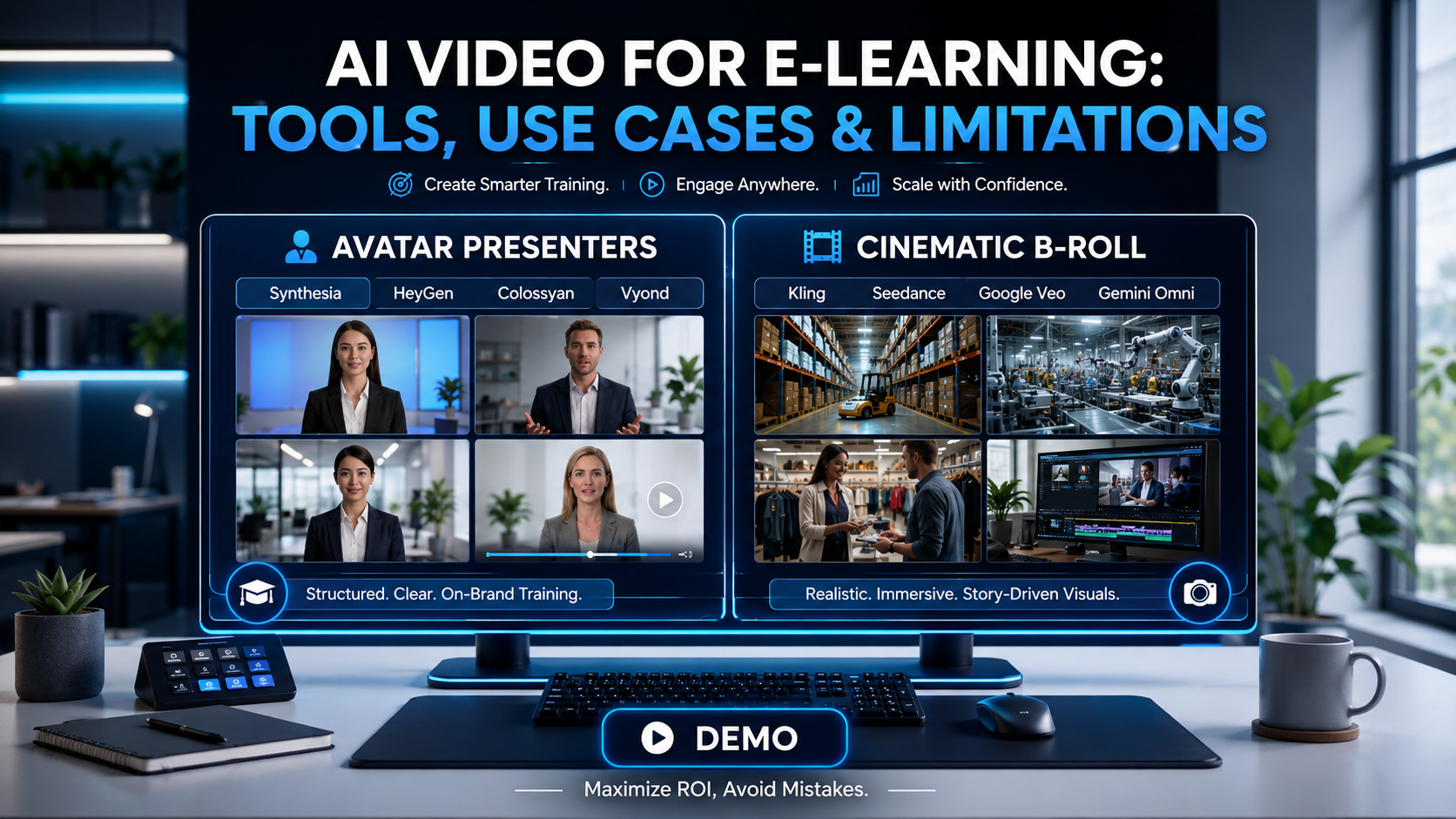
Video generation is advancing rapidly but still requires careful curation. For talking-head explainers, AI avatars from platforms like Synthesia or HeyGen are production-ready. For complex animated explainers, AI accelerates parts of the workflow but doesn't replace it end-to-end.
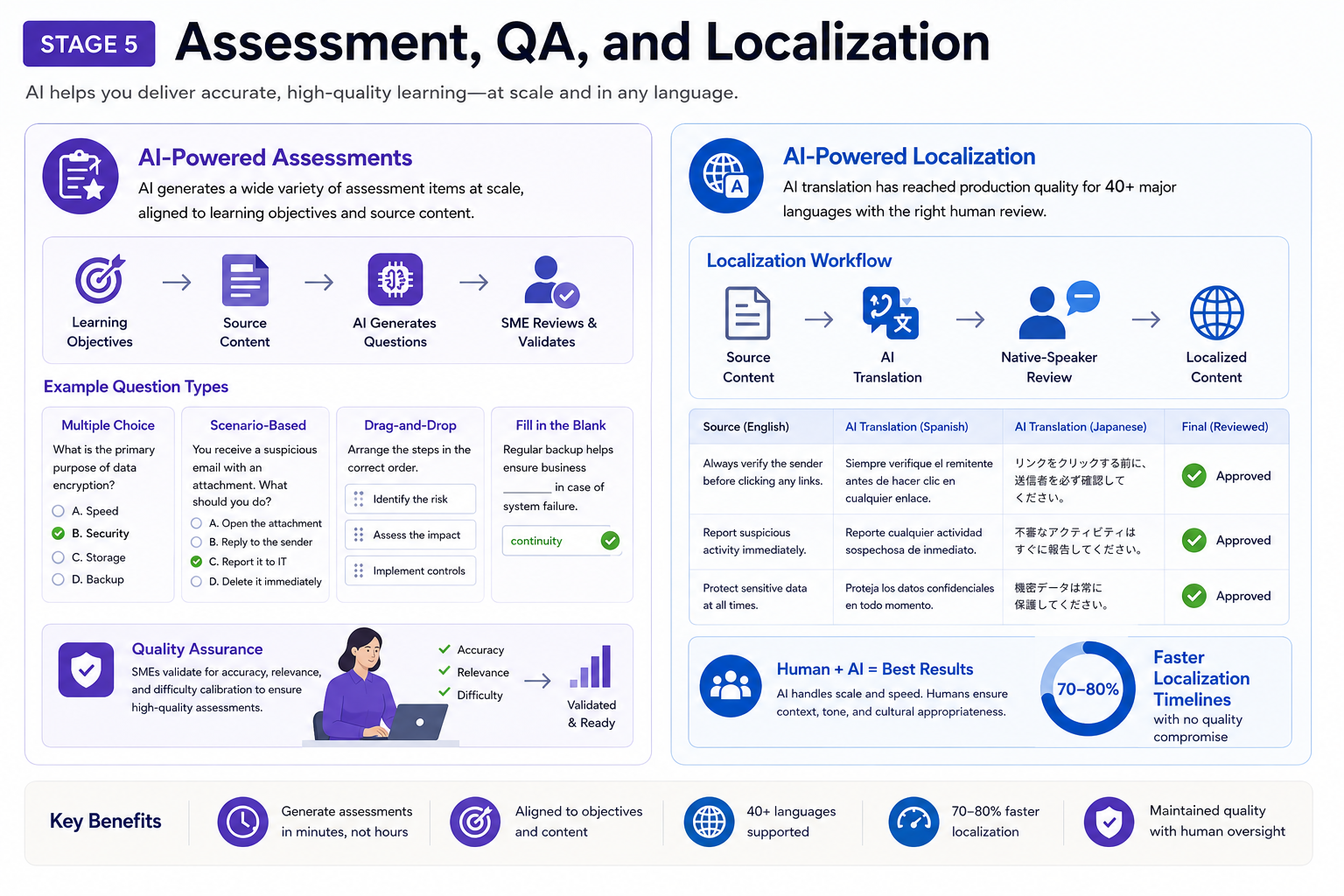
Stage 5: Assessment, QA, and Localization
For localization, AI translation has reached production quality for over 40 major languages. Pair it with a native-speaker review for any high-stakes or culturally sensitive content, and you'll cut localization timelines by 70–80% with no quality compromise.
The Quality Question: Where AI Goes Wrong and How to Prevent It
Every L&D leader considering AI has the same concern: will the quality hold up? It's a fair question. AI-generated content fails in predictable ways, and once you know what to watch for, you can engineer those failures out of your process.
Hallucinations and factual errors happen when the model is generating from its training data rather than from grounded source material. The fix is non-negotiable source grounding, every factual claim in the output must trace back to a document the model was given as input, not something it generated from memory.
Generic, formulaic content happens when prompts are too high-level. "Write a module on leadership" produces exactly what you'd expect: a forgettable middle-of-the-road draft. Specific prompts with audience details, instructional approach, examples to draw from, and tone of voice produce content that actually fits your context.
Misalignment with learning objectives is the most overlooked failure. The content reads well but doesn't actually move learners toward measurable outcomes. The fix is to anchor every AI generation request to specific, measurable learning objectives written in Bloom's taxonomy verbs, and to check every output against those objectives before approval.
Brand voice and tone drift is solved by giving the model concrete examples of your house style, three or four samples of approved past content and explicit style instructions in every prompt. Better still, build a reusable system prompt that captures your style guide and tone rules.
Pedagogical thinness is where the content covers the what but not the why or how, happens when AI is asked to produce content without an instructional design framework. The fix is to embed your design model (WHY-WHAT-HOW, 4MAT, Gagné's events of instruction, whatever you use) directly into the prompt structure.
Building the Production Workflow
Theory is helpful, but execution is where most AI initiatives stall. Here's a workflow blueprint that production teams have used successfully to scale output 4–6x while maintaining quality.
The workflow rests on three pillars: standardized prompts, structured human review, and version-controlled source libraries.
Standardized prompts help L&D teams scale eLearning content production with AI without starting from scratch for every module. Build a reusable prompt library for key content assets such as learning objectives, scripts, scenarios, assessments, and summaries. Each prompt template should include clear input fields, quality guidelines, and review checkpoints. This allows new team members to create consistent, high-quality AI-generated eLearning content from day one.
Structured human review means every AI output passes through defined quality checkpoints before moving forward. A typical four-stage review: factual accuracy (SME), instructional alignment (instructional designer), language and tone (editor), and final QA (project lead). Each stage has a checklist, not a vibe check.
Version-controlled source libraries mean your AI tools are always drawing from current, approved source content. This sounds basic but it's where most teams quietly fail. When source material is scattered across email threads, SharePoint folders, and individual laptops, AI outputs become inconsistent and risky. Centralize it.
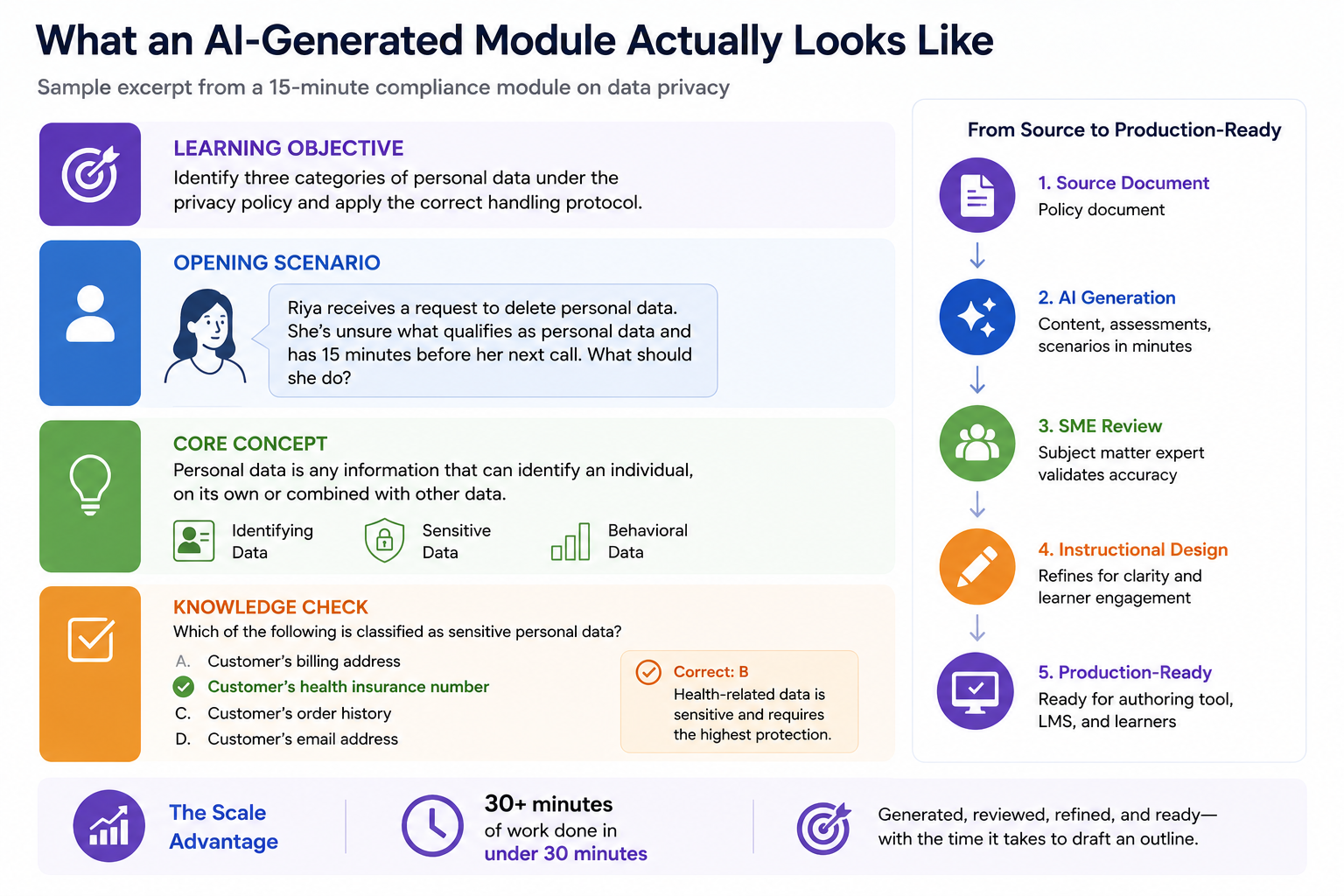
What an AI-Generated Module Actually Looks Like
To make this concrete, here's a sample of what a well-engineered AI eLearning content production workflow produces. This is a draft excerpt from a 15-minute compliance module on data privacy, generated from a source policy document in under 30 minutes:
Learning Objective: By the end of this module, learners will be able to identify three categories of personal data under their organization's privacy policy and apply the correct handling protocol to each.
Opening Scenario: "Riya, a customer support associate, receives an email from a customer asking her to delete all his personal data from the system. She knows the request is legitimate, but she's not sure which fields qualify as 'personal data' and which don't. She has fifteen minutes before her next call. What should she do?"
Core Concept Explanation: Personal data is any information that can identify a specific person, either on its own or when combined with other details. In an eLearning data privacy module, this concept can be explained by grouping personal data into three main categories: identifying data, sensitive data, and behavioral data. Each category has different handling rules, which helps learners understand how to manage personal information safely and correctly.
Knowledge Check: Which of the following is classified as sensitive personal data under the policy? a) Customer's billing address b) Customer's health insurance number c) Customer's order history d) Customer's email address (Correct answer: b. Health-related data is sensitive personal data under most privacy frameworks and requires the highest level of protection.)
This excerpt was generated, reviewed by an SME, refined by an instructional designer, and made production-ready in roughly the time it would have taken a human writer to draft an outline. Multiply that across an entire course library and the scale advantage becomes obvious.
The Economics of AI-Augmented Production
The business case for AI eLearning content production is strong, but it is important to understand where the cost savings come from.
A typical 60-minute custom eLearning module can cost between $15,000 and $35,000 to produce using traditional methods, depending on the level of interactivity, media, and design complexity. With an AI-augmented eLearning workflow, a comparable quality module can often be produced for $4,000 to $12,000, which reflects a 60 to 70% cost reduction.
These savings usually come from multiple areas of the production process. AI can reduce scripting and content development time by 40 to 50%, voiceover costs by 70 to 85%, translation and localization costs by 50 to 60%, and assessment development time by 30 to 40%. Visual design and final course development costs may remain largely unchanged.
The bigger advantage of AI in eLearning production is not only cost reduction, but also content volume. A team that previously produced 25 hours of finished learning content per year can produce 100 to 125 hours using an AI-augmented workflow. This is the real business value. Organizations are not just producing the same training content at a lower cost. They are creating more high-quality eLearning content with the same team and resources.
How to Get Started Without Disrupting Your Current Production
Most L&D teams cannot pause daily operations for a six-month AI transformation. The good news is that they do not need to. The most effective way to adopt AI in eLearning content production is to start gradually. Choose one high-volume, lower-risk content category and pilot AI workflows there before expanding across the organization.
Compliance training refreshes, product update microlearning, and assessment generation are strong starting points. These formats usually have clear source material, repeatable structures, and measurable success criteria. Avoid beginning with high-stakes leadership training, sensitive cultural training, or content that requires deep storytelling. These areas are better suited for later stages, once your team has built confidence and AI fluency.
Run a 60-day pilot with one production team, one content category, and clear success metrics such as time saved, output volume, and learner feedback quality scores. By the end of the pilot, your team will have practical data to support wider AI adoption, along with trained members who can guide others through the AI eLearning workflow.
Scaling Quality, Not Just Volume
The teams succeeding with AI eLearning content production are not simply using the most advanced AI tools. They are rebuilding their production workflows around AI’s real strengths and limitations. They use AI for high-volume tasks, keep humans involved for strategy and quality decisions, and build quality checks into every stage of the eLearning production process.
Scaling eLearning content production with AI is not only about creating more content. It is about creating the right learning content, at the right quality, for the right learners, within the time and budget your business has available. This is the shift that makes AI-augmented eLearning production valuable.
If you are ready to explore what AI-augmented content production could look like for your organization, including a custom workflow design and a sample AI-generated module built from your own source content, book a demo with our AI Content Solutions team. We will walk you through real production samples, the workflow structure, and the cost benefits specific to your content portfolio.