
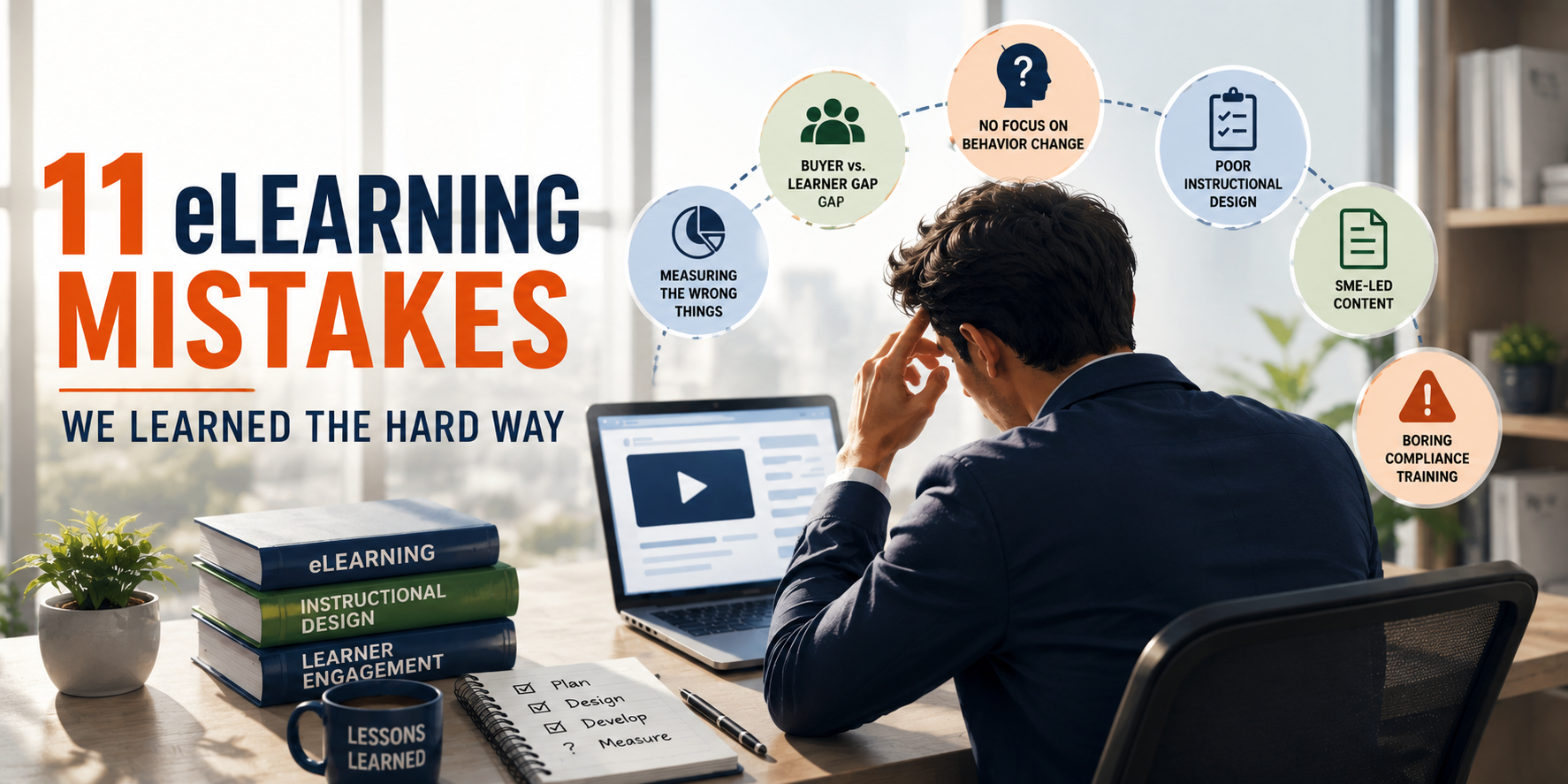
I started this company eleven years ago with a slide deck, two laptops, and a conviction that turned out to be wrong.
The conviction was that the eLearning industry's biggest problem was production cost. Bring the cost down, I thought, and good learning would become accessible to everyone. Schools, colleges, training departments they'd all stop choosing between budget and quality. We'd build the production engine that made the choice unnecessary.
Eleven years and twenty thousand hours of content later, I can tell you with absolute certainty: cost was not the problem. We solved the cost problem early. The work got cheaper. The output got faster. And learners, in many cases, were still bored, still skipping ahead, still forgetting what they'd "learned" by the following Monday.
That gap between what we built and what learners actually got out of it has been the most expensive education of my career.
I want to write this essay honestly, because most of what gets published about our industry is sanitized in a way that doesn't help anyone. We tell prospective clients about our wins. We don't tell them about the projects that taught us the most, which were almost always the ones that didn't go well. So here it is. The eleven things I genuinely believe now that I didn't believe when I started, and a few I'd argue with people who do this work for a living.
The Industry Confuses "Built" with "Learned"
This is the one I'd put on a billboard if I could.
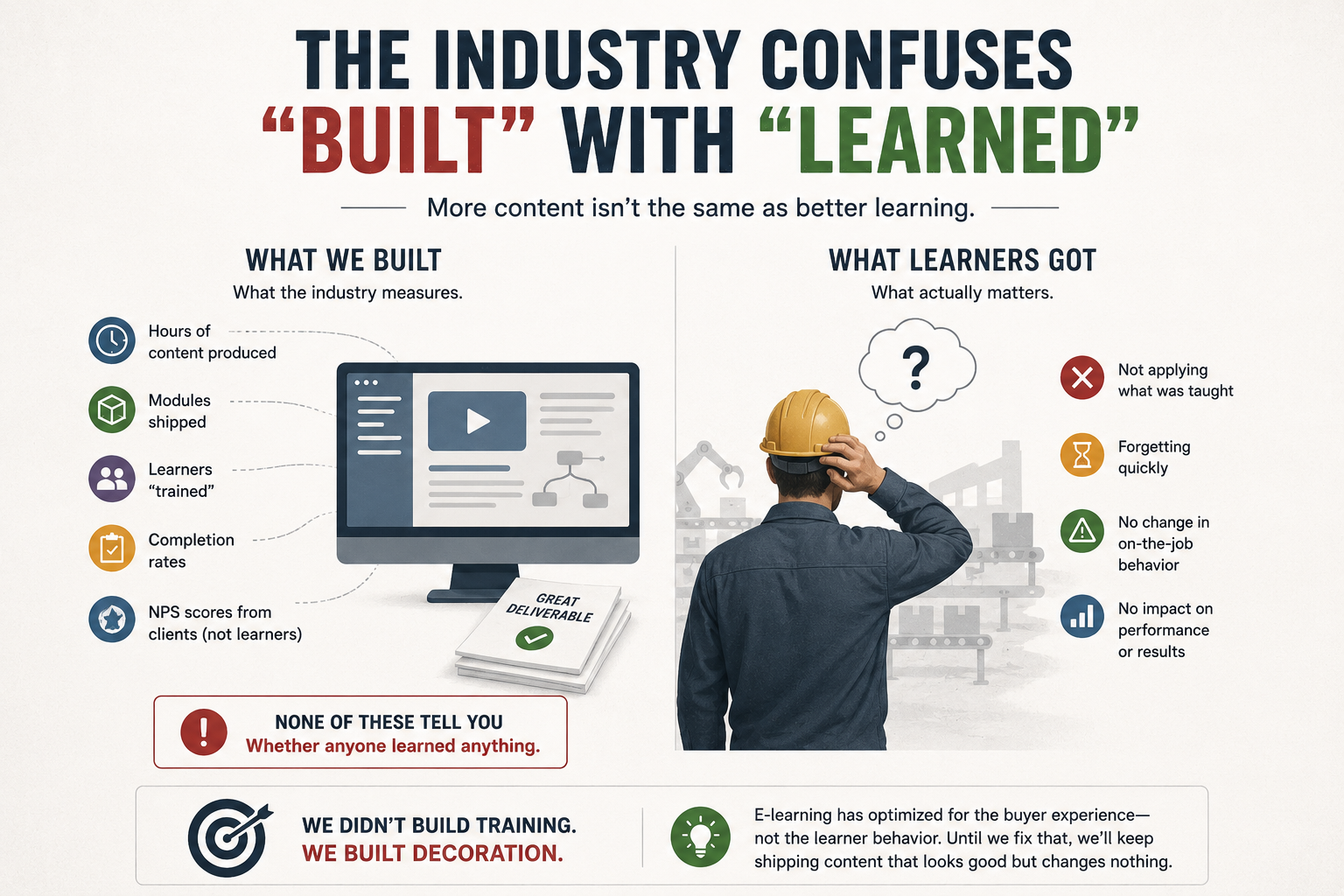
For the first three or four years, we measured ourselves the way the whole industry measures itself. Hours of content produced. Modules shipped. Learners "trained." Completion rates. NPS scores from clients who, importantly, were not the learners.
None of those metrics tells you whether anyone learned anything.
I remember a project, a big one, well-paid, looked great in our portfolio, where we delivered forty hours of beautifully produced content for a manufacturing client. Crisp visuals, professional voiceover, branching scenarios, the works. Six months later, the same client came back and asked us to produce a second version of the same content. Why? Because nobody on the floor was doing the things the training covered.
We hadn't built training. We'd built decoration.
The hard truth I've come to is that most of what gets called "eLearning" in the corporate world is content delivery, not learning design. We've optimized for the experience of the buyer, usually an L&D manager who needs to show a roadmap to leadership, and not for the behavior of the learner. That's a problem the industry doesn't really want to talk about, because talking about it makes a lot of existing work look weaker than it is.
Instructional Design Without Behavior Change Is Decoration
Related to the above, but worth saying separately.
Beautiful storyboards, elegant interactions, on-brand visuals, and well-structured assessments are not the same as a learner doing something differently on Monday morning. I've watched teams obsess over animation timing on a module that, ultimately, was teaching the wrong thing entirely.
The single most useful question I learned to ask, somewhere around year five, is this: What do you want a specific person to do differently after this training, and how will you know? If the client can't answer that in one sentence, we don't have a learning project. We have a content project. Those are different things, priced differently, scoped differently, and measured differently. Pretending they're the same has cost our industry billions in wasted spend.
Most "Engagement" Metrics Measure Politeness, Not Learning
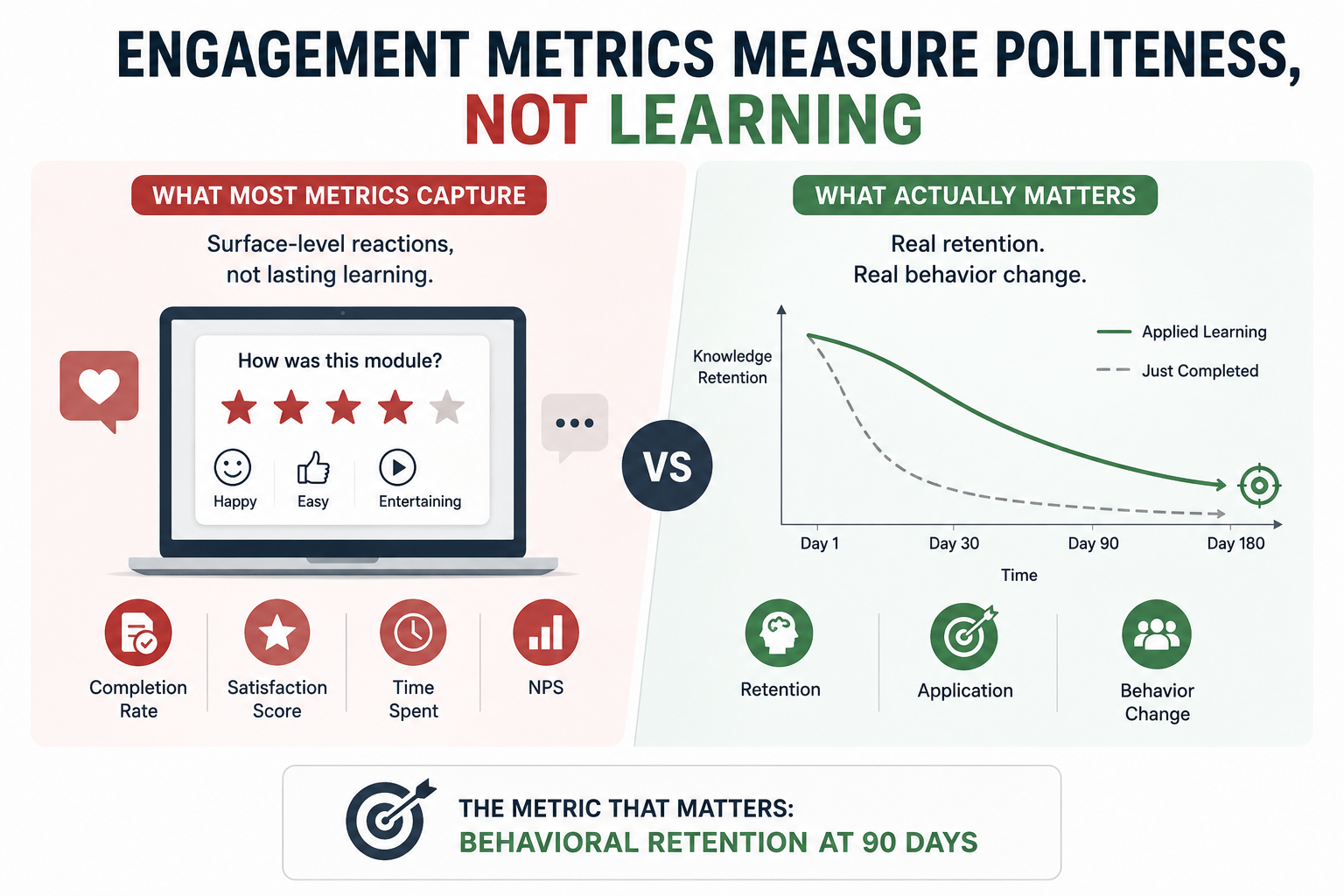
We used to celebrate when a module got high engagement scores. Then I started watching learner behavior more carefully and realized something uncomfortable. Learners gave positive ratings to modules they couldn't remember anything from a week later. They gave higher ratings to easier modules, regardless of what they actually contained. They gave the highest ratings of all to modules that felt entertaining.
None of those are signs of learning. Some of them are signs of the opposite. Real learning often feels effortful in the moment. The modules I'm most proud of, looking back, are not the ones with the highest immediate satisfaction scores. They're the ones where, six months later, someone could still apply what they learned.
I'd love to see the industry develop a new metric, something like "behavioral retention at 90 days," and make it the default success measure. We're nowhere close to that. We're still chasing the post-module survey.
The Buyer and the Learner Are Different People, and That's the Whole Problem
Eleven years in, I'm convinced this is the structural flaw at the heart of the corporate eLearning industry.
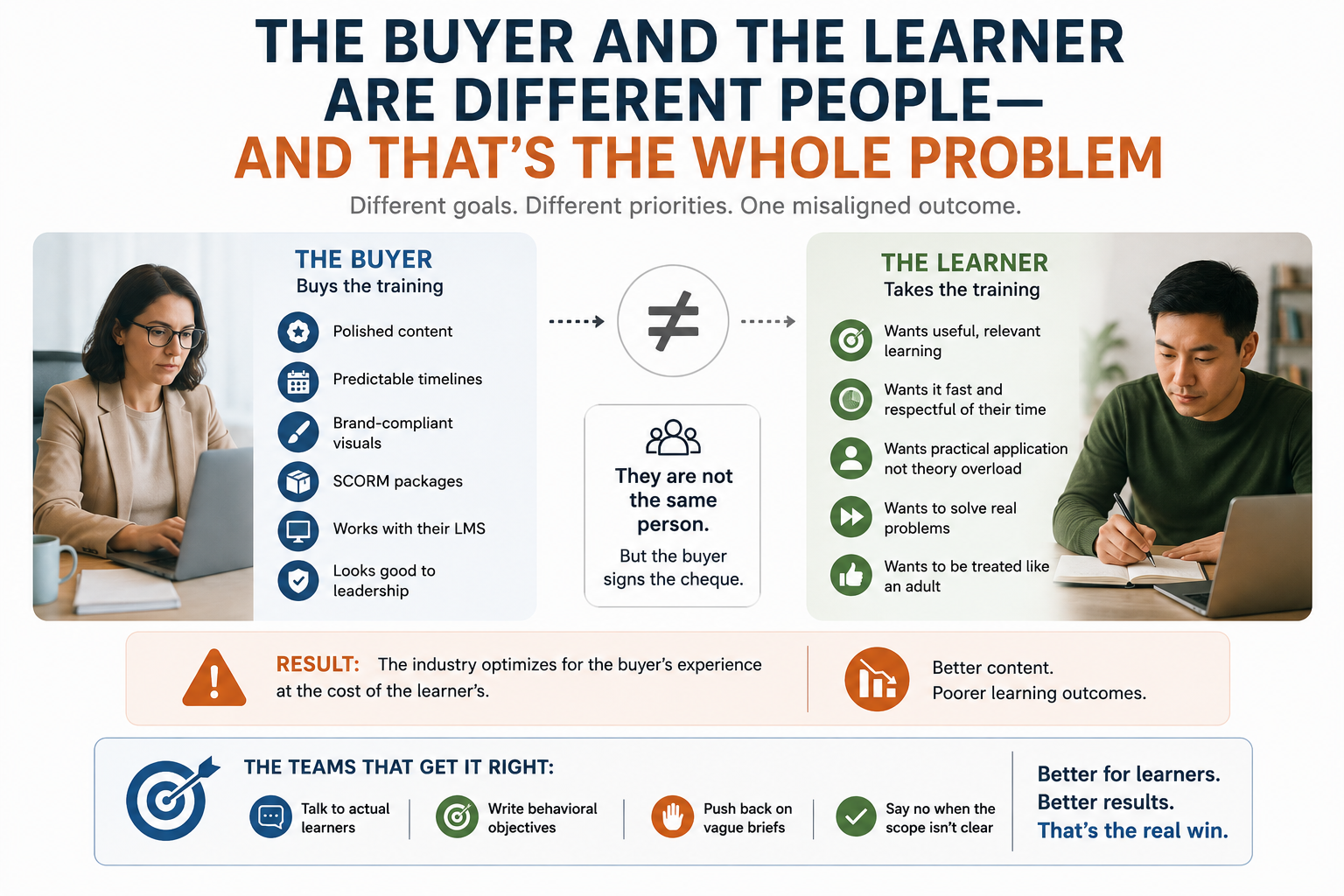
The person buying the training is rarely the person taking it. The buyer wants polished content, predictable timelines, brand-compliant visuals, and SCORM packages that play nicely with their LMS. The learner wants to learn something useful, fast, and without being patronized.
These are not the same product. And because the buyer signs the cheque, the industry has slowly drifted toward optimizing for the buyer's experience at the cost of the learner's.
The teams I respect most are the ones who push back against their own clients on this. Who insist on talking to actual learners during design. Who writes learning objectives in behavioral terms and refuses to soften them. Who says no to projects where the brief is "we need a module on X" without any further specificity? We've gotten better at this over the years. Not perfect. Better.
Subject Matter Experts Are Not Content
This one took me longer to figure out than it should have.
For years, we'd interview SMEs, capture everything they said, structure it, polish it, and ship it. It looked like instructional design. It wasn't. It was SME-led content with an instructional design veneer.
The problem is that experts don't actually know how they know what they know. They've internalized so much pattern recognition that the actual decision points the parts a novice needs to understand are invisible to them. If you transcribe an expert and structure their words, you get an expert-shaped lecture, not a learning experience.
Real instructional design starts with the learner's current model of the world and figures out the smallest, most leveraged moves to get them to a more useful model. That's a different process. It's harder. It requires real ID craft. And most production studios, ours included, for our first several years, were not doing it. We were doing SME transcription with better lighting.
Compliance Training Doesn't Have to Be Soul-Destroying, But It Almost Always Is
I'll say something contrarian here that will annoy a portion of my industry: most compliance training is worse than no training at all.
It exists to document that the training happened, not to change behavior. The buyer knows this. The learner knows this. Everyone clicks through. Nobody learns anything. The organization has its audit trail, the learner has their certificate, and the actual risk the training was meant to address is essentially unchanged.
We've produced compliance training that broke this pattern. It can be done. It requires scenario-based design, real consequences, decisions that feel weighty, and a willingness from the client to make their compliance training actually difficult enough that some people will need a second attempt. Most clients, when push comes to shove, don't want this. They want 100% completion and 100% pass. Which means they want a ritual, not a course.
I've stopped pretending this is anything other than what it is. Sometimes we produce these. We're honest with the client about what they're buying. That honesty, I've found, builds better long-term relationships than the alternative.
Localization Is Not Translation
I learned this one expensively, in front of a client who deserved better.
We localized a leadership programme for a multinational. Translated everything carefully. Used native speakers for voiceover. The works. The Indian rollout went fine. The Brazilian rollout went fine. The German rollout went poorly. The Japanese rollout went so badly that the client asked us to redo the whole thing.
The mistake wasn't linguistic. The Japanese translation was excellent. The mistake was cultural. The scenarios we'd built around assertive disagreement, direct feedback, and individual ownership simply did not map to a workplace context where harmony and group consensus are foundational. The translation was perfect. The content was wrong.
Real localization changes scenarios, examples, names, hierarchies, decision contexts, and sometimes the underlying assumptions about what good behavior even looks like. It costs more, takes longer, and is the only thing that actually works. The industry's habit of treating localization as a translation step is one of the things we get wrong most consistently.
Technology Doesn't Save Bad Design
I've watched VR come and go (well, mostly go), AR have a moment, microlearning rise and plateau, gamification overpromise and underdeliver, adaptive learning genuinely deliver but only in narrow cases, and AI now sweep through everything.
Here's the pattern. Every new technology gets sold as a solution to the engagement and effectiveness problems we've never solved. Each one helps a little, in specific cases, when applied by people who already understand good design. None of them rescues a project that was poorly designed to begin with.
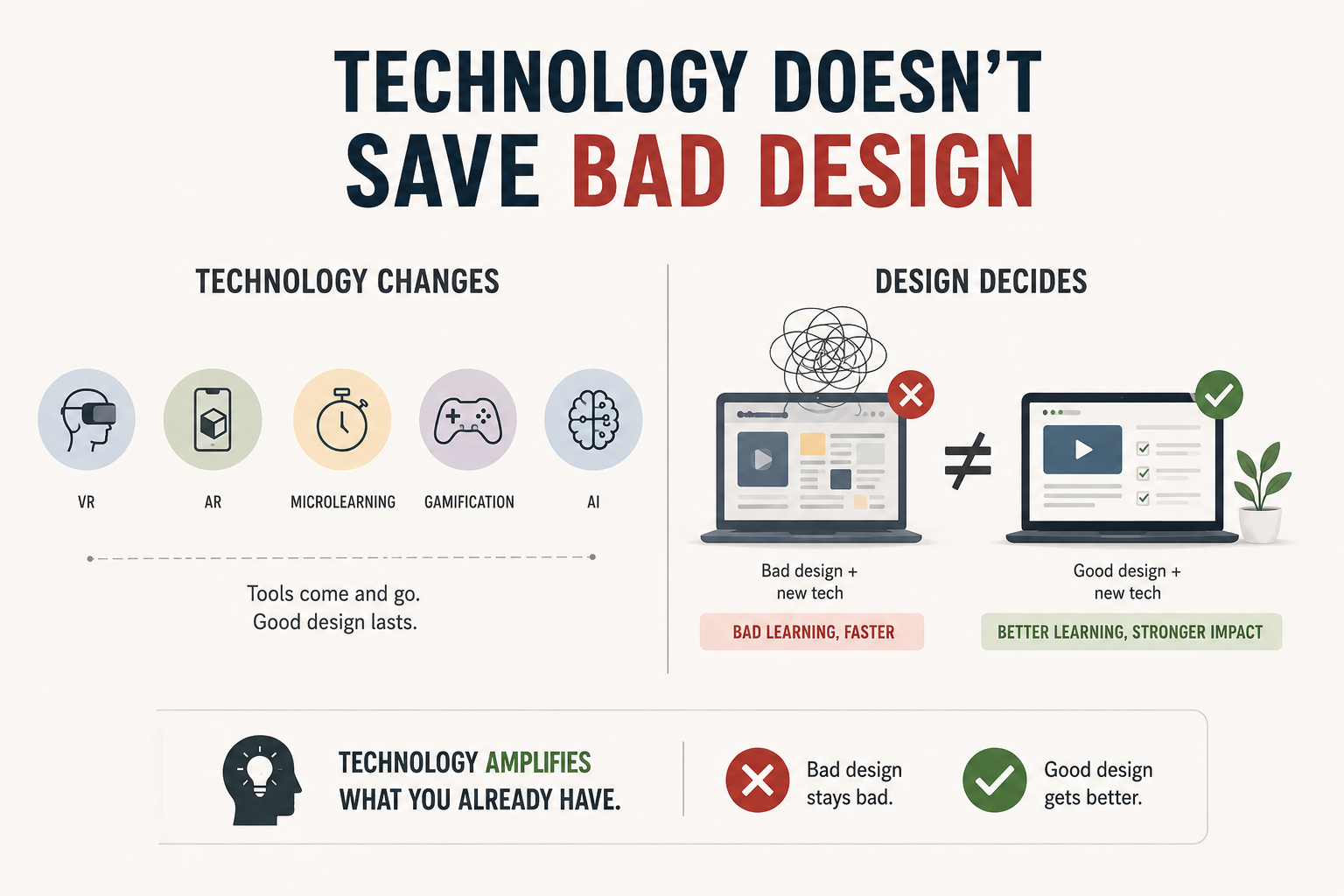
AI is the most powerful of these waves, and I genuinely believe it changes the economics of production permanently. But it doesn't change what makes learning effective. The teams that will win with AI are the teams that already knew how to design good learning. The ones who didn't will use AI to produce bad learning faster, which is not the win they think it is.
We Underestimated the Manager
For our first many years, we treated training as a transaction between a course and a learner. The learner takes the course. Behavior changes. Done.
What actually happens is much messier. The learner takes the course, returns to a workplace where their manager either reinforces or undermines what they learned, where systems either support or punish the new behavior, and where peers either model the new behavior or roll their eyes at it.
If the manager doesn't reinforce, the training evaporates within weeks. We've measured this. It's not a small effect. It's an enormous one. And the manager is almost never part of our scope. They're not in the brief. They're not invited to the design conversation. They're not given anything to do.
If I could go back and add one thing to every project we've done, it would be a manager enablement layer. Even a small one. A two-page guide on what to talk about with the learner in the first week after they finish the module. Anything. Because the gap between the learning and the workplace is where almost all the training value either survives or dies.
Smaller Modules Win More Often Than We Admit
For a long time, the industry kept producing 45 and 60-minute modules because that's what the LMS expected, that's what completion reports were structured around, and that's what felt like a "real" module to the buyer.
Learners hated them. They still hate them.
The best results we've seen, consistently, come from modules in the 8 to 15 minute range, designed for a single objective, tightly scoped, and delivered close to the moment of need. Not because attention spans have shortened (I'm sceptical of that whole narrative), but because that's the chunk size that actually fits how working adults learn between meetings and operational pressure.
We still produce long modules when clients want them. We do less of it than we used to. When clients trust us to design around the learner instead of the LMS report, we almost always end up shorter, more focused, and more effective.
The Last One Is About Us, Not the Work
Eleven years in, the thing I'm proudest of has nothing to do with the content we've built. It's the team.
Forty-plus people, mostly in Mumbai, some scattered across India, who have stayed through good years and rough years. People who push back on briefs that don't serve learners. People who tell clients hard truths instead of comfortable ones. People who take the craft of instructional design seriously enough to argue about it in meetings.
I used to think this business was about content. It's not. It's about whether the people producing the content actually give a damn about the people receiving it. Every meaningful improvement we've made over eleven years has come from someone on this team caring enough to say, "this isn't good enough, let's do it again."
You can't manufacture that. You can only hire for it and protect it. We try.
Where That Leaves Us
I don't have a neat conclusion to offer you. Eleven years in, I'm more uncertain about parts of this industry than I was at the start, and more certain about others.
What I'm certain about: the gap between content production and actual learning is the single biggest problem worth solving. Most of the industry isn't solving it. The teams that do solve it will own the next decade.
What I'm less certain about: which technologies will matter in five years, which delivery formats will survive, which client expectations will hold, and which will shift. I've been wrong enough times now to know that confident predictions in this industry age badly.
If you've read this far, you probably work in or around L&D yourself. I'd genuinely like to hear what you've seen go wrong, what you've fixed, and what you're still wrestling with. The thing I've come to value most after eleven years is a candid conversation with someone else who's done this long enough to be honest about what doesn't work.
If that's you, drop me a note. Talk to me directly. No pitch, no demo, no sequence of follow-up emails. Just a conversation between two people who care enough about this work to be honest about it.
That's what got me into this in the first place. Eleven years in, it's still the part I value most.