
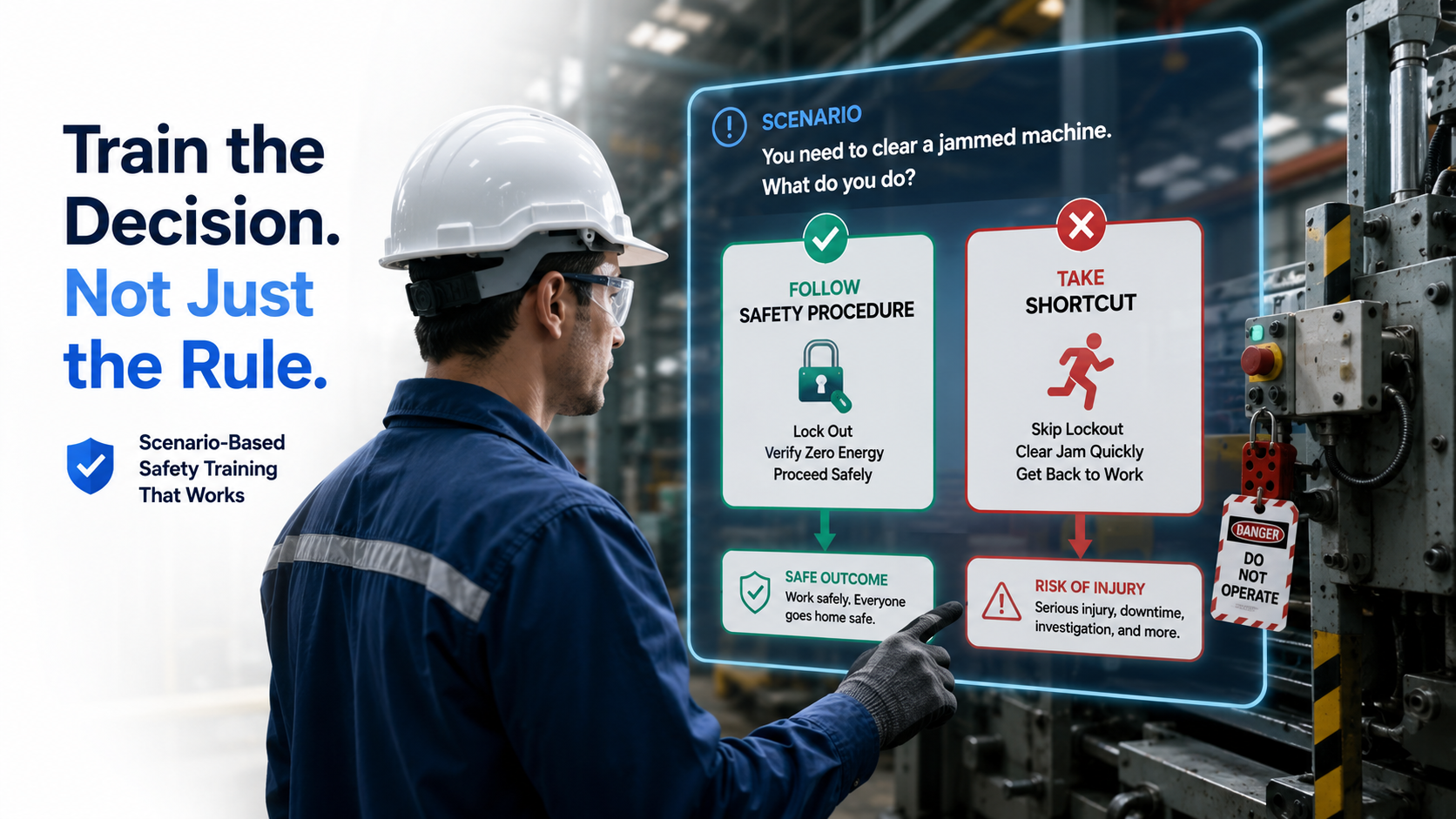
I've stood on a lot of plant floors over the years. And I've reviewed a lot of safety training that those plant floors were supposedly running on. The gap between the two is one of the most dangerous things in our industry, and I mean that literally, not as a figure of speech.
Here's the pattern I've seen too many times. A manufacturer has a binder of safety procedures and a library of compliance modules. Completion rates are excellent 98%, 99%, everyone's certified. The audit trail is spotless. And then someone reaches into a machine that should have been locked out, or skips a step on a confined-space entry, or stacks a load wrong, and the consequences are catastrophic.
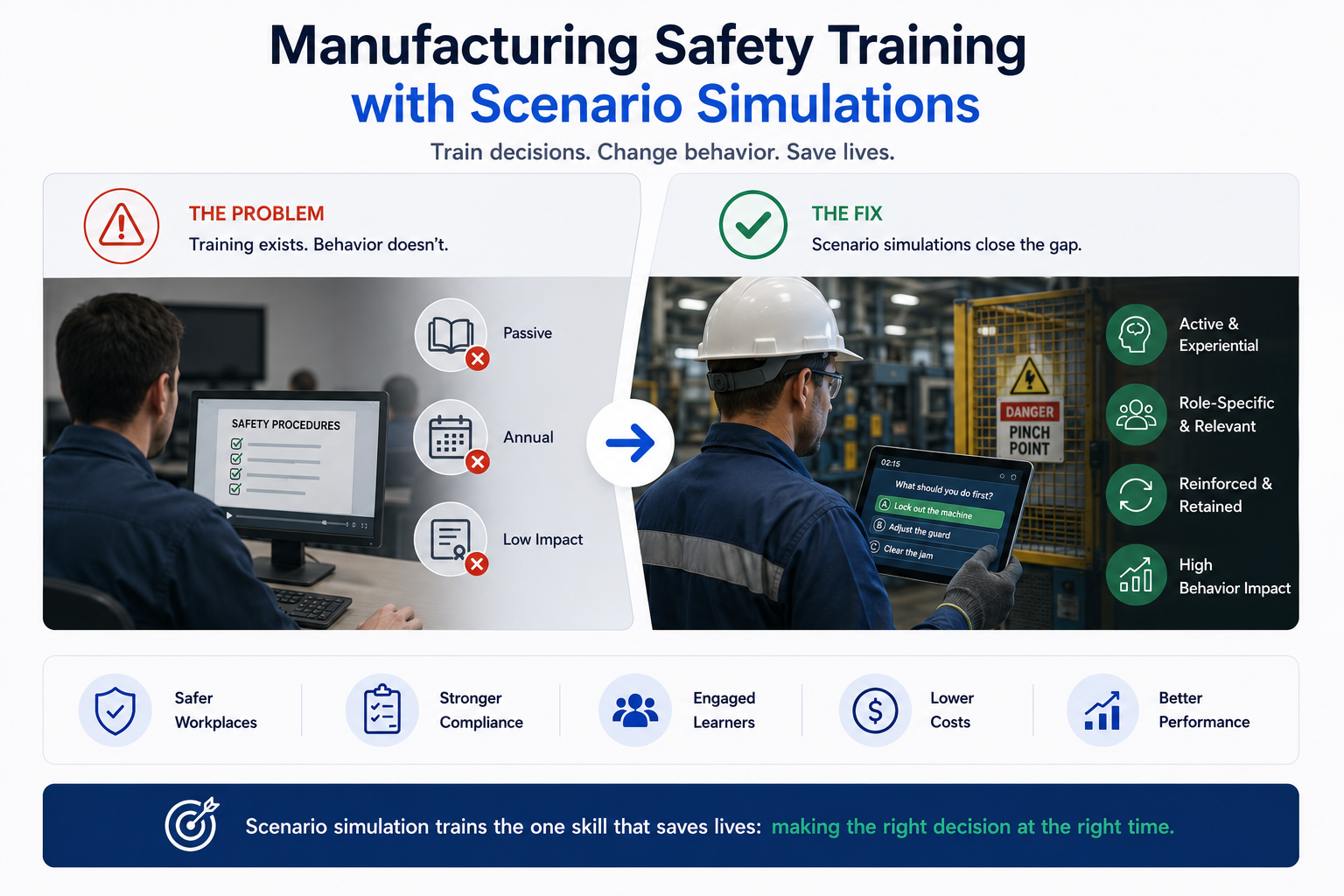
The training existed. The certificates existed. The behavior didn't change.
That gap is what this guide is about. If you're responsible for safety training in a manufacturing environment, you already know that click-through modules and annual refreshers aren't moving the needle on actual floor behavior. You're not wrong. The format is the problem. And scenario simulation is, in my experience, the single most effective fix available, not because it's trendy, but because it trains the thing that actually matters: decision-making under real conditions.
Let me walk you through why and what good actually looks like.
Why Traditional Safety Training Fails on the Floor
Most manufacturing safety training is built to satisfy a regulator, not to change a worker's behavior. That's the root of the problem, and once you see it, you can't unsee it.
Think about what a typical safety module asks of a learner. Read this procedure. Watch this video. Answer these multiple-choice questions, where the correct answer is usually obvious from how the question is worded. Get your certificate. None of that resembles the moment that actually matters on the floor, the split second when a worker, under time pressure, with a supervisor watching and a quota to hit, has to decide whether to follow the safe procedure or take the shortcut everyone else takes.
Knowing the rule and applying the rule under pressure are completely different skills. Traditional training only addresses the first. It builds knowledge. It does not build judgment. And on a plant floor, judgment under pressure is the whole game.
There's a second failure, too. Recall decays fast. A worker who passes a lockout/tagout module in January has forgotten most of the nuances by March. Annual refresher cycles guarantee that for most of the year, your workforce is operating on faded memory. The training calendar is built around audit convenience, not around how human memory actually works.
This isn't a knock on your team. It's a knock on the format. You can have the best EHS people in the industry and still get poor floor outcomes if the training format can't transfer to the floor. The format is the constraint.
What Scenario Simulation Actually Does Differently
Scenario simulation flips the entire model. Instead of presenting information and testing recall, it drops the learner into a realistic situation and makes them decide, then shows them the consequences of that decision.
That's the keyword: consequences. In a well-built safety simulation, when a learner chooses to skip the lockout step because "the line's only down for a second," they see what happens next. Not a "wrong answer, try again" pop-up. The actual chain of events is the machine activating, the near-miss or the injury, the incident report, and the investigation. The simulation makes the abstract consequence concrete and emotional, which is exactly how humans actually learn to avoid danger.
This matters because real safety decisions are never made in the clean conditions of a quiz. They're made with competing pressures. Production is behind. A colleague is waiting. The proper procedure takes four extra minutes. The shortcut has worked a hundred times before. A good simulation builds all of those pressures into the scenario, so the learner practices making the right call under the same forces they'll face on the floor.
You're not teaching them the rule. They probably already know the rule. You're rehearsing the decision, repeatedly, in a safe environment, until the safe choice becomes the automatic one. That's what changes floor behavior. That's what a binder and a slideshow can never do.
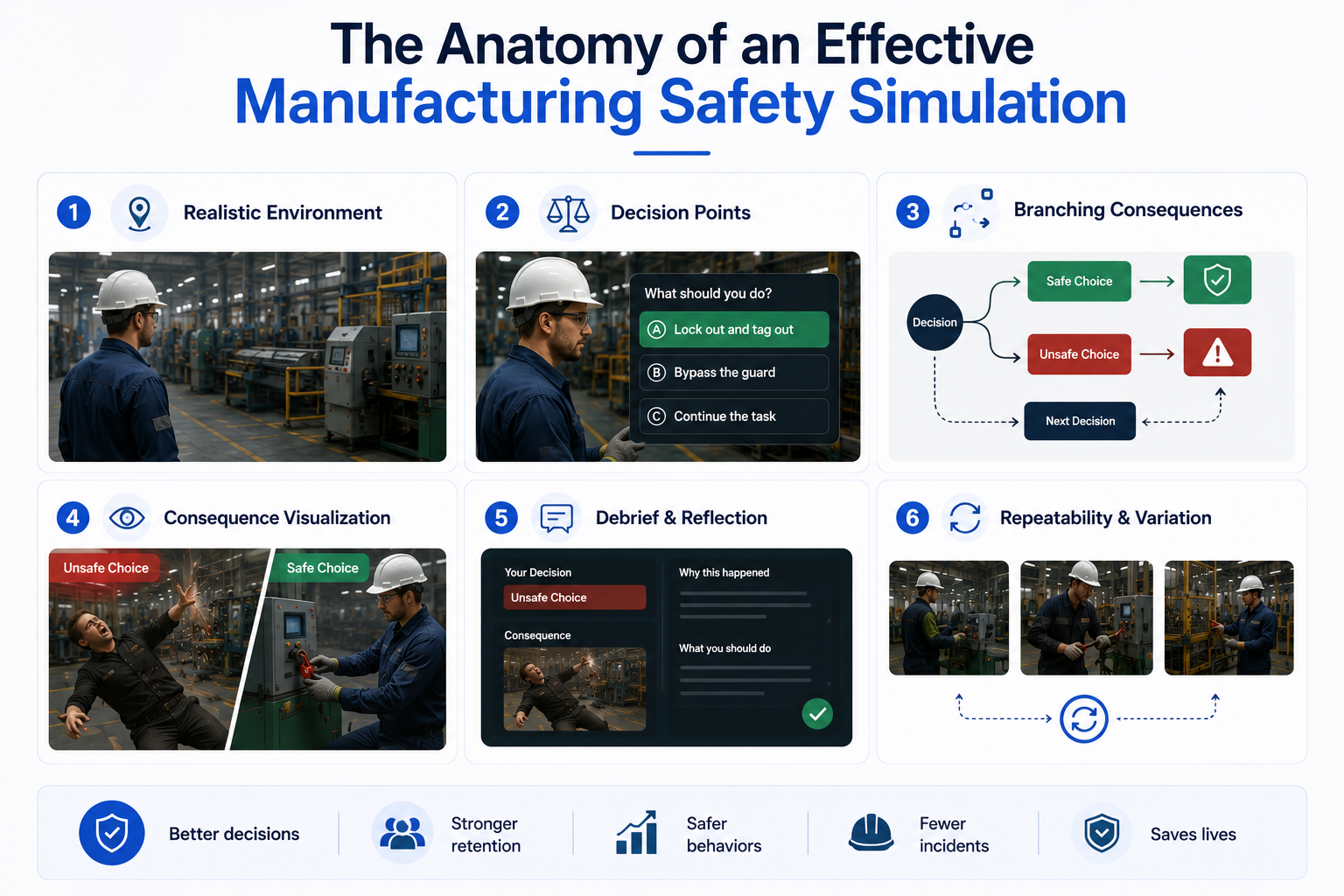
The Anatomy of an Effective Manufacturing Safety Simulation
Not all "scenario-based" training is created equal. I've seen plenty of modules that slap a workplace photo behind a multiple-choice question and call it a simulation. That's not it. Here's what genuinely effective manufacturing safety simulations actually contain.
A realistic, specific environment. Generic stock-footage factories don't land. The simulation should reflect your environment, your equipment, your processes, and your actual hazards. A worker recognizes their own machine, their own line, their own conditions. That recognition is what makes the learning transfer. Recognition is half the battle.
Genuine decision points with real stakes. The learner makes choices that matter, where the wrong choice leads somewhere bad, and the right choice isn't always the obvious or easy one. The decisions should mirror the real tension between safety and productivity, because that tension is where real incidents are born.
Branching consequences. This is the technical heart of it. Different decisions lead to different outcomes, which lead to further decisions. A learner who makes an early mistake should be able to see how it compounds, or how a good recovery decision can still salvage the situation. Linear "right/wrong" content can't do this. Branching scenarios can.
Consequence visualization. When something goes wrong in the simulation, the learner should see it and feel it. Not gore for shock value, but a clear, honest depiction of what the unsafe decision leads to. The emotional weight is part of the pedagogy. People remember how something made them feel far longer than they remember a bullet point.
Debrief and reflection. After the scenario, the learner needs to understand why their decisions led where they did, what the correct approach was, and how to apply it. The decision teaches; the debrief cements. Skip the debrief, and you've built a video game, not a training tool.
Repeatability and variation. Workers should be able to run scenarios multiple times, encountering variations, so the safe decision becomes a deeply ingrained habit rather than a one-time memory. This is also where the recall-decay problem gets solved short, repeatable scenario refreshers throughout the year beat one big annual module every time.
High-Value Scenario Types for Manufacturing
When we work with manufacturing clients, certain scenario categories deliver outsized returns. If you're prioritizing where to start, these are where scenario simulation earns its keep fastest.
Lockout/Tagout (LOTO). The single highest-value safety simulation in most manufacturing environments, because LOTO failures are common, catastrophic, and almost always a decision failure rather than a knowledge failure. Workers know the procedure. Under pressure, they skip it. A simulation that rehearses the decision under realistic time pressure is enormously effective.
Confined space entry. High-stakes, procedure-heavy, and unforgiving of shortcuts. Scenario simulation lets workers practice the full decision sequence, atmospheric testing, permits, attendant communication, and emergency response without the real-world risk of getting it wrong.
Machine guarding and pinch-point awareness. These incidents happen in the gap between knowing a guard should be in place and the daily temptation to bypass it for speed. Scenarios that make the consequence vivid change the calculus.
Hazardous material handling. Spills, exposure, PPE decisions, and emergency response. The branching nature of chemical incidents, where one decision cascades into others, is perfectly suited to simulation.
Forklift and powered industrial truck operation. Pedestrian interaction, load handling, and blind corners. Scenario simulation builds the situational awareness that real operations demand.
Emergency response and evacuation. Low-frequency, high-consequence events where people have no muscle memory because they almost never happen for real. Simulation is the only safe way to build that muscle memory before it's needed.
The Business Case: Why This Pays for Itself
I want to be direct about the economics, because if you're going to take scenario simulation to your leadership, you need the business case, not just the safety argument.
Safety incidents are extraordinarily expensive. A single serious injury carries direct costs, medical, workers' compensation, regulatory penalties, and far higher indirect costs: lost production, equipment damage, investigation time, increased insurance premiums, and the morale hit across a workforce that just watched a colleague get hurt. Industry estimates routinely put the fully-loaded cost of a single lost-time incident in the tens of thousands of dollars, and a serious one far higher.
Against that, the cost of building effective scenario simulations is modest, and the modules are reusable across your entire workforce for years. If better training prevents even one serious incident, it has typically paid for itself many times over. That's not a hard ROI conversation to have.
There's a regulatory dimension too. Demonstrating that your safety training actually builds competency, not just completion, strengthens your position considerably if a regulator ever comes asking. "We require certification" is a weak defense. "We train decision-making through validated scenario simulations and track competency, not just completion" is a strong one.
And there's a recruitment and retention angle that's easy to overlook. Workers notice when an employer takes their safety seriously enough to train them properly. In a tight manufacturing labor market, a genuine safety culture is a real differentiator.
Common Mistakes When Moving to Scenario-Based Safety Training
Having helped manufacturers make this shift, let me save you the predictable mistakes.
Mistake one: making scenarios too generic. If the simulation doesn't reflect your actual environment, equipment, and hazards, the learning doesn't transfer. Invest in customization. A generic LOTO scenario is dramatically less effective than one built around your specific machines and procedures.
Mistake two: keeping the "everyone passes" mindset. Traditional compliance training is built so that everyone passes. Effective scenario training should let people fail safely in the simulation, because failure is where the learning happens. If your scenarios are designed so that no one ever makes the wrong choice, you've defeated the purpose. Resist the urge to make them easy.
Mistake three: treating it as a one-time event. The biggest gains come from short, repeatable scenario refreshers distributed throughout the year, not one big annual simulation. Build for repetition, not for the audit calendar.
Mistake four: skipping the floor-level input. The best scenarios are built with input from the people who actually do the work, experienced operators, and floor supervisors who know where the real shortcuts and real risks live. Build scenarios in a conference room without floor input, and you'll miss the situations that actually cause incidents.
Mistake five: forgetting the supervisor layer. A worker can make perfect decisions in a simulation and still take shortcuts on the floor if their supervisor signals that production beats safety. Scenario training works best when supervisors are trained too, and when the floor culture reinforces what the simulation teaches.
Getting Started Without Disrupting Production
You can't shut down a plant to roll out new training, and you don't need to. The approach that works is targeted and incremental.
Start with your highest-risk, highest-frequency hazard, usually LOTO or whatever your incident data flags as your biggest exposure. Build a single, genuinely excellent scenario simulation for that one hazard, customized to your environment. Roll it out to one shift or one line. Measure the results, not just completion, but near-miss reporting, observed behavior, and incident data over the following months.
Use that pilot to build the internal case, then expand hazard by hazard. Within a year, you can have a scenario-based safety program covering your major risks, built on evidence that it works in your specific environment, with a workforce that's experienced the difference.
The key is to start with the hazard where the stakes are highest, and the current training is weakest. That's where scenario simulation proves its value fastest.
Train the Decision, Not Just the Rule
After two decades in this work, here's what I'd want every manufacturing safety leader to take away.
Your workers almost certainly know the rules. The certificates on file prove they can pass a test. But safety incidents don't happen because people don't know the rules. They happen because, in a pressured moment, someone makes the wrong decision, and no slideshow ever prepared them for that moment.
Scenario simulation prepares them for that moment. It rehearses the decision, under realistic pressure, with real consequences, until the safe choice becomes the automatic one. That's the difference between training that fills a binder and training that sends people home safe at the end of every shift.
If you'd like to explore what scenario-based safety training could look like for your specific operation, built around your equipment, your hazards, and your actual incident history, book an industry consultation with our team. We'll talk through your highest-risk areas, show you examples of scenario simulations and interactive modules we've built for manufacturing environments, and map out a pilot that proves the value before you commit to a full program.
The worst safety training is the kind that looks complete on paper and fails on the floor. Let's build the kind that works where it counts.