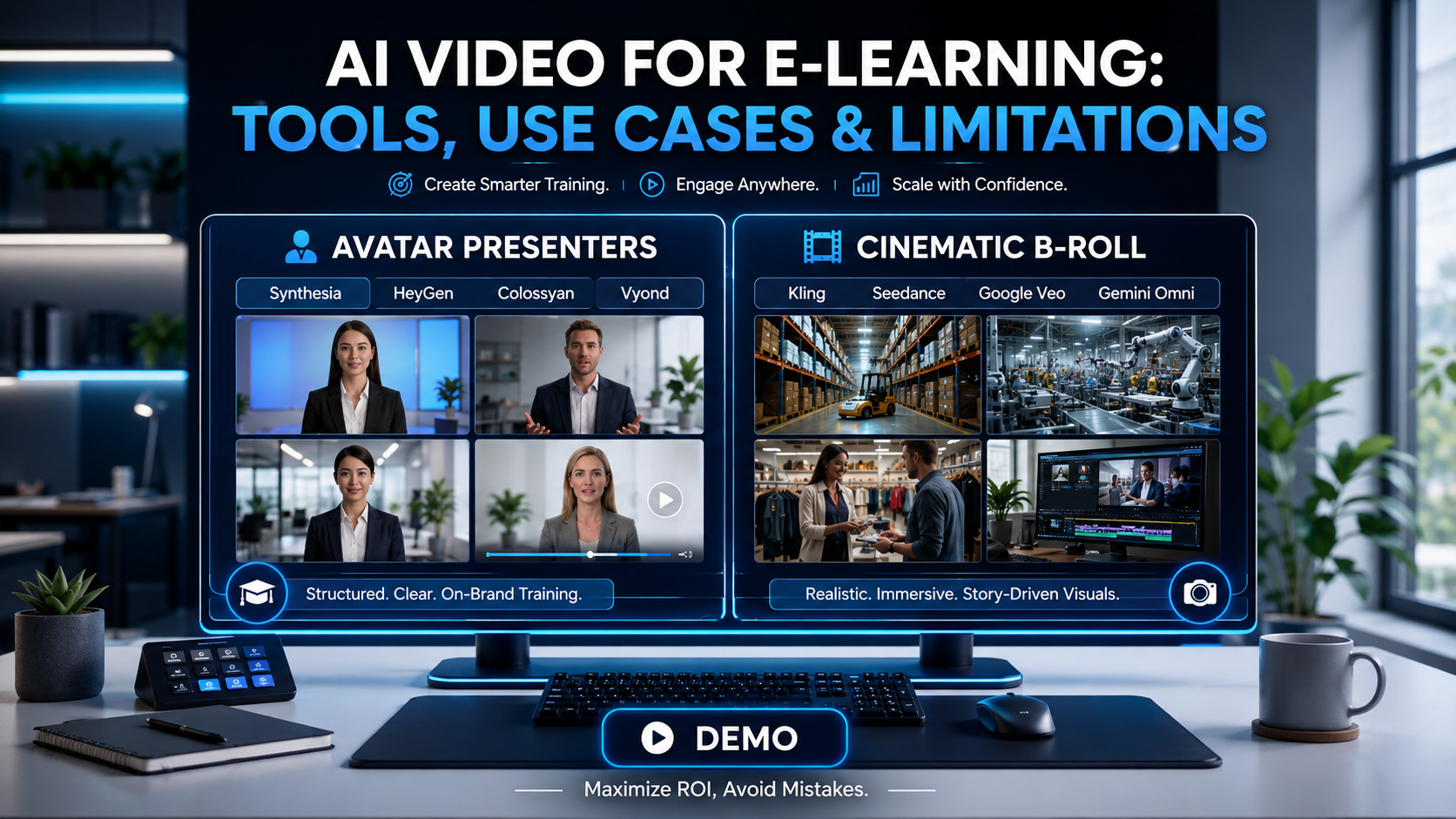
If you've spent any time building eLearning, you've probably lived inside Articulate Storyline or Adobe Captivate for most of it. You know the workflow: storyboard, build, review, revise, publish, repeat. It works. It's always worked.
But over the last couple of years, a new category of tools has entered the conversation. Generative AI platforms purpose-built for L&D are now serious contenders. And the question a lot of instructional designers and L&D managers are asking is a fair one: does AI actually replace these tools, or is this just another wave of hype that won't survive contact with a real content deadline? If you haven't worked through whether to build in-house or outsource yet, start with our guide on in-house vs outsourced eLearning development.
This comparison is meant to answer that question practically. No jargon, no vendor cheerleading. Just an honest look at where traditional authoring tools still shine, where generative AI pulls ahead, and why the smartest L&D teams are finding that the real answer sits somewhere between both.
What We Mean by "Traditional Authoring Tools"
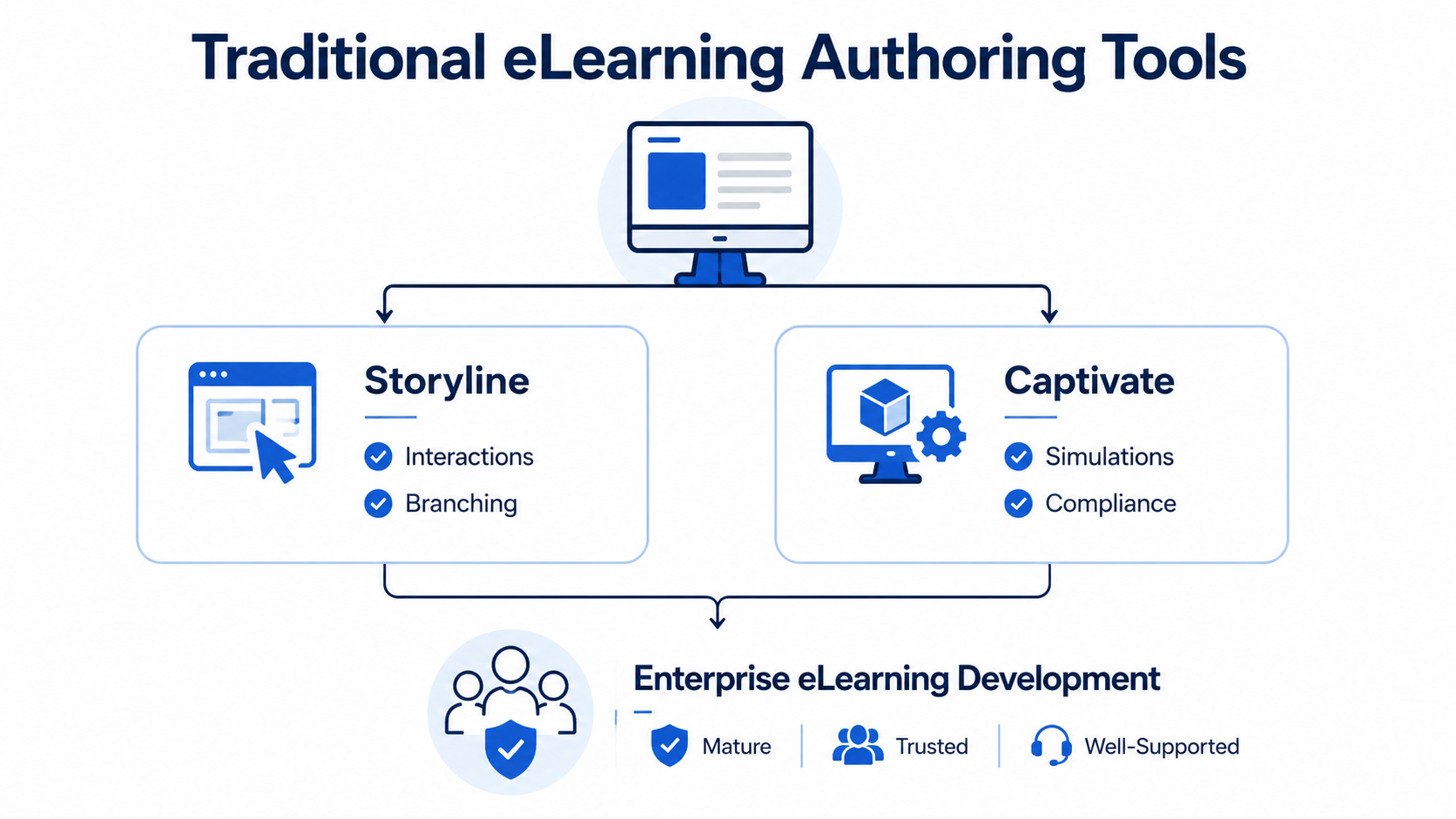
When people say authoring tools, they usually mean one of two platforms.
Articulate 360 (Storyline + Rise) has long been the industry standard. Storyline gives you fine-grained control over interactions, branching scenarios, and custom animations. Rise is faster and better suited to responsive, scroll-based content. Between the two, Articulate covers a lot of ground.
Adobe Captivate has a steeper learning curve but a stronger foothold in enterprise environments, particularly for software simulations and compliance training. It integrates well with other Adobe products and handles complex branching logic well.
Both platforms are mature, well-supported, and trusted by organizations that have invested years building templates, libraries, and internal expertise around them.
What Generative AI Tools Actually Do in L&D
This is where a lot of the confusion starts. "AI in eLearning" can mean a dozen different things depending on who's talking. For this comparison, we're focusing on generative AI platforms specifically designed to assist or accelerate the content production process. Tools that can draft scripts, generate assessments, produce voiceovers, suggest learning objectives, structure course outlines, and, in some cases, build entire learning modules from a brief.
These are not slide builders with a chatbot bolted on. The better ones are built around instructional design logic, which means they understand the difference between a knowledge check and a performance-based scenario, and they produce outputs that actually make sense in a learning context.
The Core Comparison: Six Dimensions That Actually Matter
1. Speed to First Draft
This is where generative AI wins decisively, and it's not particularly close.
With Articulate or Captivate, getting to a first draft means someone has already written the script, approved the storyboard, and started building slides. That process can take days or weeks, depending on subject matter complexity and SME availability.
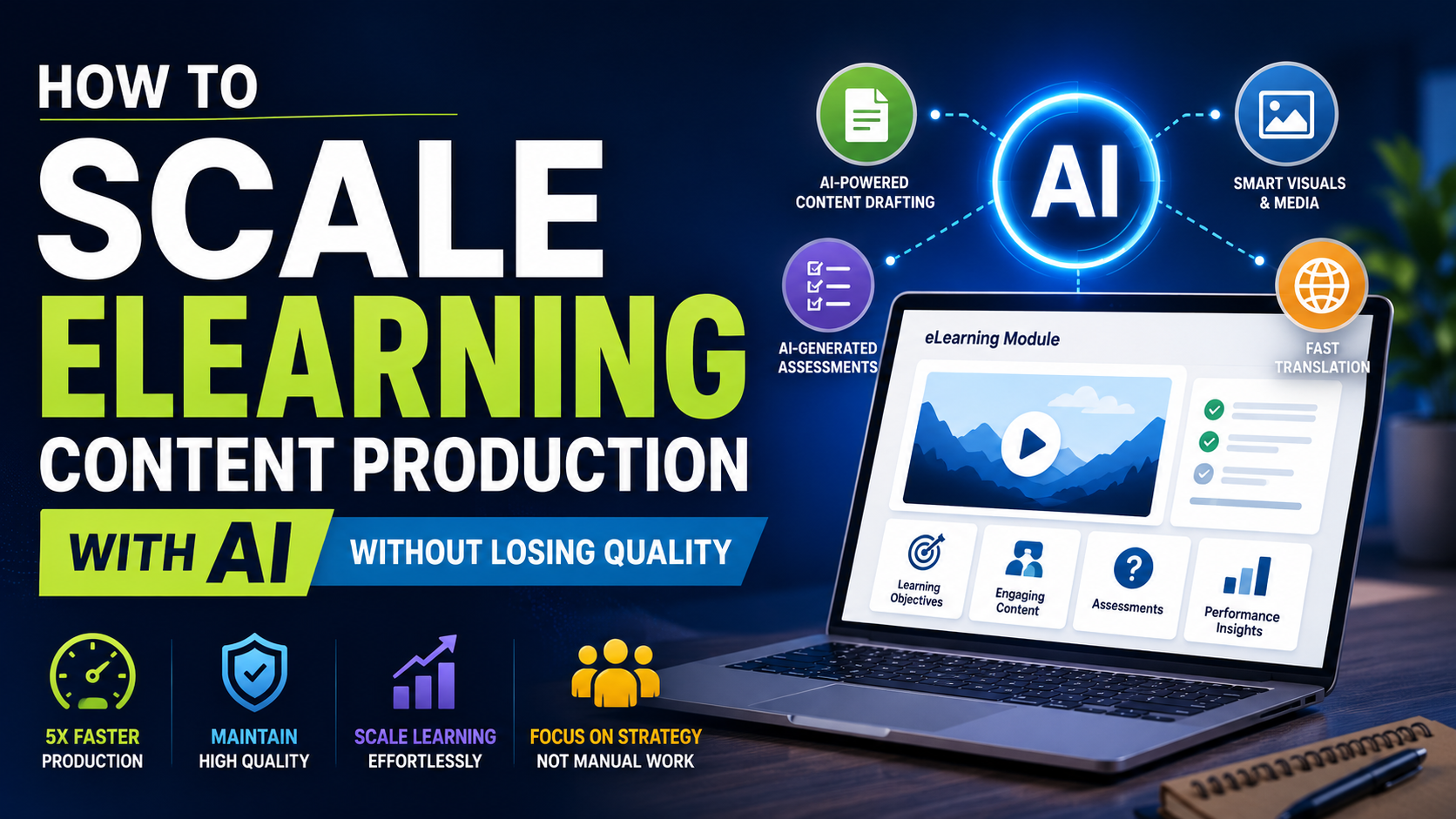
Generative AI can take a topic brief, a PDF, or even a recorded subject matter expert conversation and produce a structured course outline, draft narration scripts, and a set of knowledge checks in a fraction of that time. What used to take a team a week can become a working starting point in an afternoon. For a deeper look at how this works at volume, see our guide on scaling eLearning content production with AI without losing quality.
For L&D teams under pressure to produce more content faster, and that is most L&D teams, this is a meaningful difference.
2. Design Flexibility and Visual Customization
Here, traditional tools have a clear advantage.
Articulate Storyline gives experienced designers near-total control over how a course looks and behaves. Custom animations, intricate branching, pixel-level layout control, complex states, and variables. These are things a skilled Storyline developer can do that no generative AI platform currently matches.
Rise is more constrained by design, but that constraint also makes it faster for teams without dedicated eLearning developers. Captivate sits somewhere in the middle, with strong templating capabilities and solid simulation-recording features.
AI-generated content, at least right now, tends toward structure over style. It can produce clean, learner-friendly layouts. But if you need a fully branded, highly interactive experience with custom motion graphics and adaptive branching, you are still building that in a traditional tool or handing polished AI content off to a developer to enhance.
3. Instructional Quality Out of the Box
This one is more nuanced than most comparisons acknowledge.
Traditional authoring tools are exactly that: tools. They do not write content for you. Articulate does not know if your learning objectives are measurable or if your scenario choices are realistic. The quality of what gets built in Storyline depends entirely on the instructional designer using it.
Generative AI, when built with proper instructional design logic, can actually scaffold better learning design into the process. A well-designed AI tool will prompt for learning objectives before generating content, apply Bloom's taxonomy to assessment items, and flag when a module is trying to cover too much ground. That is instructional design built into the workflow, not just writing assistance.
That said, AI still needs a human with L&D expertise to review outputs critically. It can produce content that looks structurally sound but misses nuance, oversimplifies complex topics, or generates quiz questions that test recall when the performance goal requires application. The tool does not eliminate the need for instructional judgment. It shifts where that judgment gets applied.
4. Localization and Scale
If you are producing content for a global workforce, this dimension matters a lot.
Traditional tools handle localization through a manual process. You export text, send it to translators, re-import, fix layout issues caused by text expansion, review, and republish. For 10 courses in 8 languages, that is a significant operational lift.
Generative AI dramatically changes this equation. Modern AI platforms can translate content directly, adjust for regional context, and in some cases generate localized voice-overs without requiring a full studio process. What used to take months of localization work can happen in parallel with course development.
For organizations scaling content across markets, this alone can justify the shift.
5. Maintenance and Updates
Think about how often your compliance training needs to be updated. Or your onboarding content after a product launch. Or your process documentation after a system change.
In a traditional authoring workflow, updating a course means finding the source file, making edits, republishing, and pushing the updated version to your LMS. If the original developer has left or the file is not properly version-controlled, this gets complicated quickly.
Generative AI platforms often keep content in an editable, structured format that makes updates significantly faster. Change a product name, update a policy, swap out a section. The AI can help you make those changes consistently across a course or even a full curriculum.
This is an underrated advantage, especially for teams maintaining large content libraries.
6. Total Cost and Resource Requirements
The pricing models are quite different, and the right choice depends on your context.
Articulate 360 is subscription-based and well-priced for what it offers, but the real cost is the expertise required to use it well. A competent Storyline developer takes time to develop or costs money to hire. Complex courses can take 40 to 80 hours of development time per finished hour of content.
Generative AI tools typically operate on a per-seat or usage-based model, and they are designed to be accessible to people who are not dedicated eLearning developers. An L&D manager with strong subject matter knowledge can produce publishable content without needing to master a complex tool.
The tradeoff is ceiling versus floor. Articulate's ceiling is high. In skilled hands, it produces exceptional learning experiences. AI tools lower the floor. Almost anyone can produce competent content quickly. The right model depends on what you are optimizing for.
Where Each Tool Category Actually Belongs
After going through these dimensions, here is a practical framework for thinking about when to use what.
Use traditional authoring tools when:
The course requires complex branching scenarios or simulations
You need custom interactivity that goes beyond standard templates
Brand standards require pixel-perfect visual design
You are building flagship content with a long shelf life and high production value
Your team has dedicated eLearning development expertise
Use generative AI when:
You need to produce a high volume of content on shorter timelines
You are working with SMEs who do not have time for long storyboarding cycles
Content will need frequent updates or versioning
You are localizing for multiple languages or regions
You want to build out a curriculum quickly before investing in high-production-value flagship courses
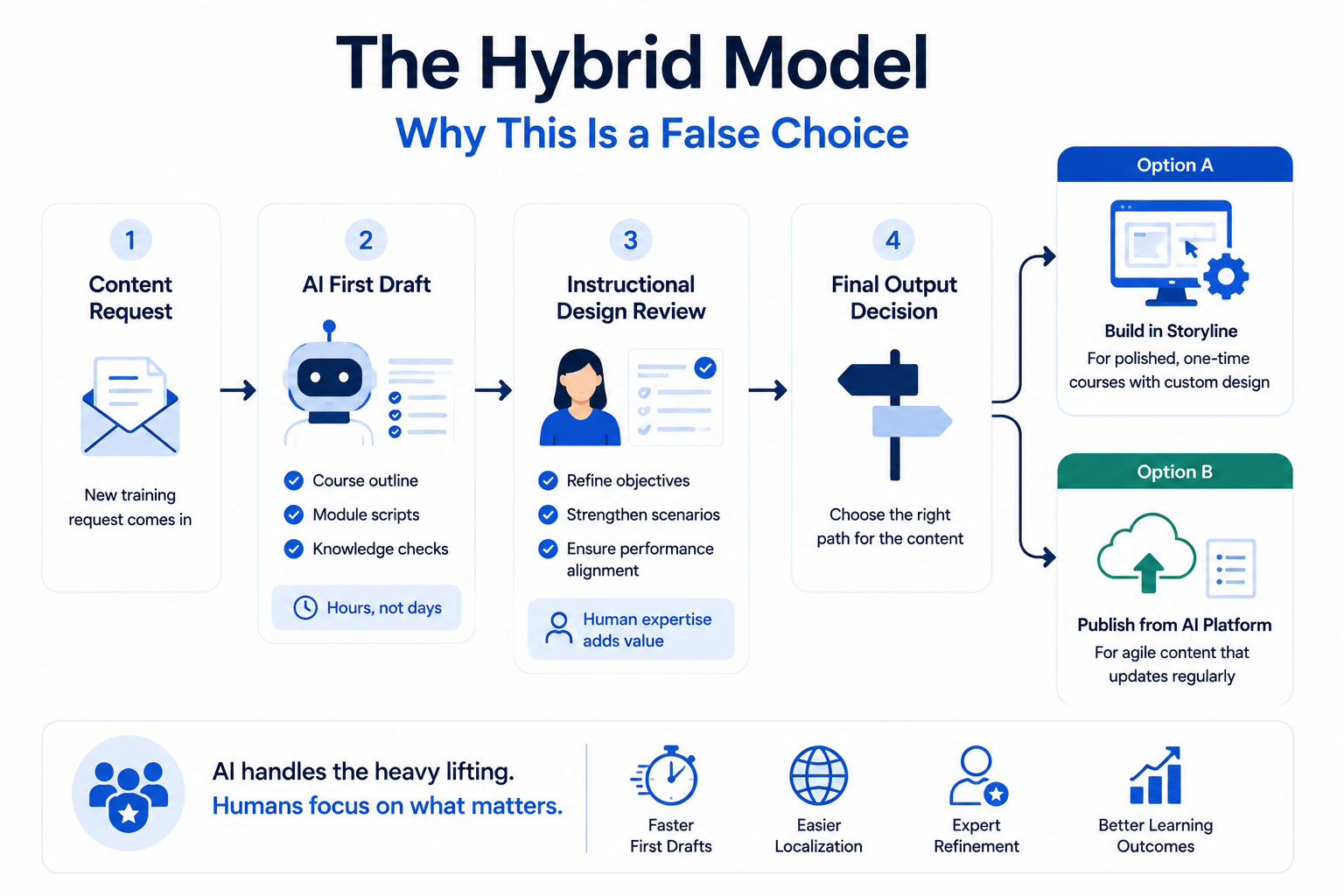
The Hybrid Model: Why This Is a False Choice
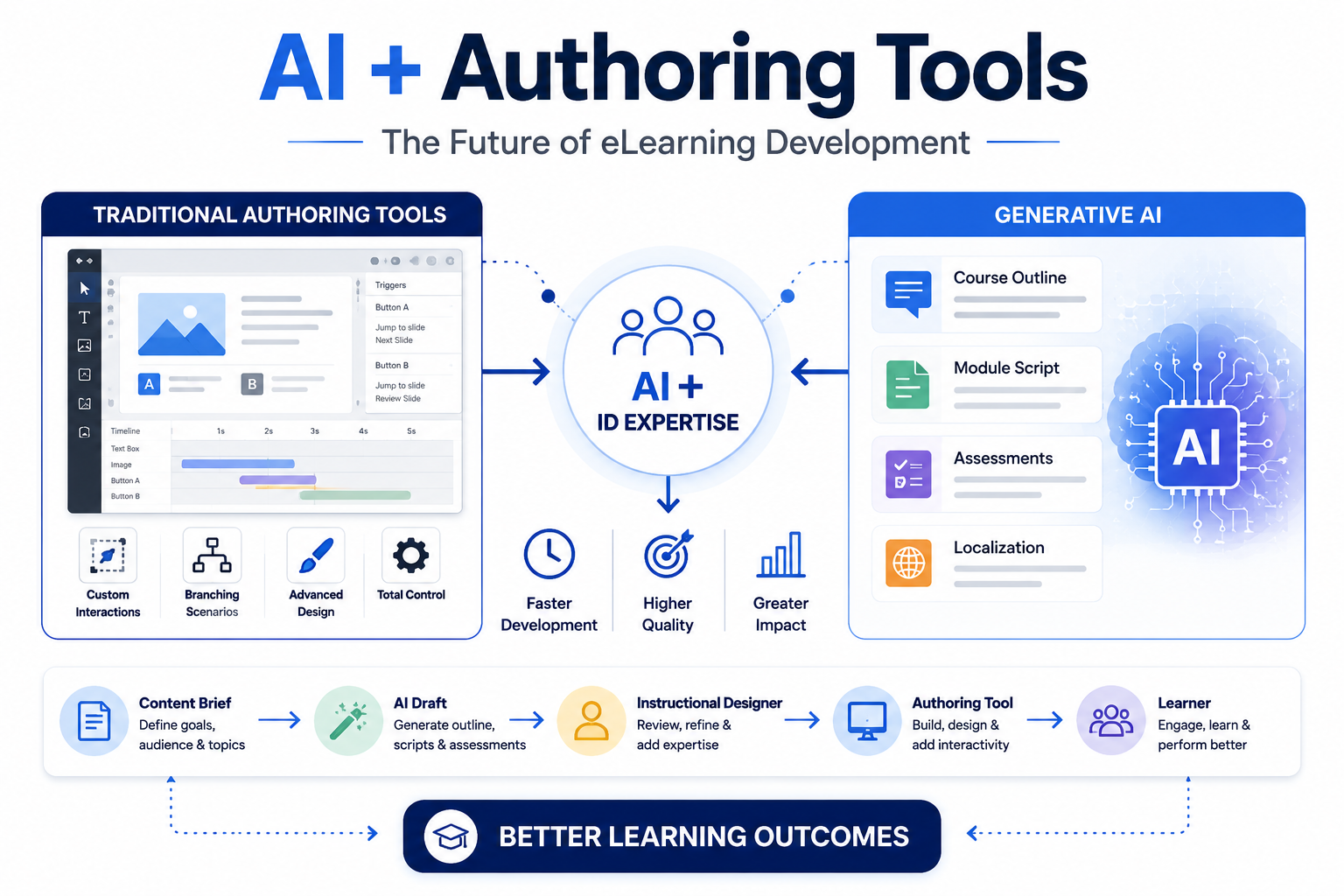
Here is the thing most comparisons miss: the best L&D teams are not choosing between AI and Articulate. They are using both at different stages and for different purposes.
A realistic hybrid workflow looks like this.
A content request comes in, say, a new product training for the sales team. Instead of starting from a blank Storyline file, an instructional designer uses an AI platform to generate a course outline, draft module scripts, and create a first pass at knowledge checks. This takes a few hours instead of a few days.
That draft then goes through instructional design review. A human with L&D expertise refines the learning objectives, strengthens the scenario design, and makes sure the content actually maps to performance goals. The AI produced the structure. The expert refines the substance.
For the final output, a decision is made. If this is a one-time course that needs to look polished, it might get built in Storyline with a custom design. If it needs to live in an agile content library that gets updated regularly, it might stay in the AI platform's native format and get published directly to the LMS.
This is not AI replacing instructional designers. It is AI eliminating the parts of the process that do not require human expertise, the blank-page problem, first-draft friction, and localization overhead, so that the people with L&D knowledge can spend their time on the parts that actually matter.
What to Look for in a Generative AI Platform for L&D
If you are evaluating AI options to sit alongside your existing authoring tools, a few things are worth prioritizing.
Instructional design logic baked in. Look for platforms that understand learning design, not just content generation. Can it help you write measurable objectives? Does it produce assessments that align with the right cognitive levels? Does it understand the difference between microlearning and a full course?
LMS compatibility. Your AI-produced content needs to get to learners. Make sure the platform outputs SCORM, xAPI, or whatever your LMS requires without a painful export process.
SME collaboration features. One of the biggest efficiency gains from AI comes from reducing the friction between subject matter experts and content creators. Look for tools that make it easy for SMEs to contribute and review without needing to learn eLearning software.
Human override and editorial control. AI is a starting point, not a final answer. The best platforms make it easy for your team to review, edit, and refine outputs rather than lock you into whatever the model produces.
Data and iteration support. Can you see how learners are performing? Can you use that data to improve content? Platforms that close the feedback loop between learner behavior and content improvement are significantly more valuable long-term.
The Bottom Line on AI vs Articulate in eLearning
Articulate and Captivate are not going away. They are powerful, mature platforms with large communities and deep functionality that generative AI does not replicate, at least not yet.
But they were built for a world where content production was slow, specialized, and expensive. That constraint shaped everything about how they work.
Generative AI was built for a different set of constraints: faster timelines, leaner teams, more frequent updates, and global distribution. It does not replace instructional design expertise. It changes where that expertise gets applied and how much more it can produce with the same resources.
The teams winning in L&D right now are not choosing sides in this debate. They are pairing AI-powered production speed with genuine instructional design thinking, and the result is content that gets built faster, stays current longer, and actually moves the performance needle.
That combination of AI capability plus ID expertise is what the next generation of L&D looks like.
Ready to See What AI-Powered L&D Production Looks Like in Practice?
Creaitify is built for L&D teams who need to produce more without sacrificing quality. If you want to see how generative AI and instructional design expertise can work together in your workflow, Book a Demo and we will walk you through it.