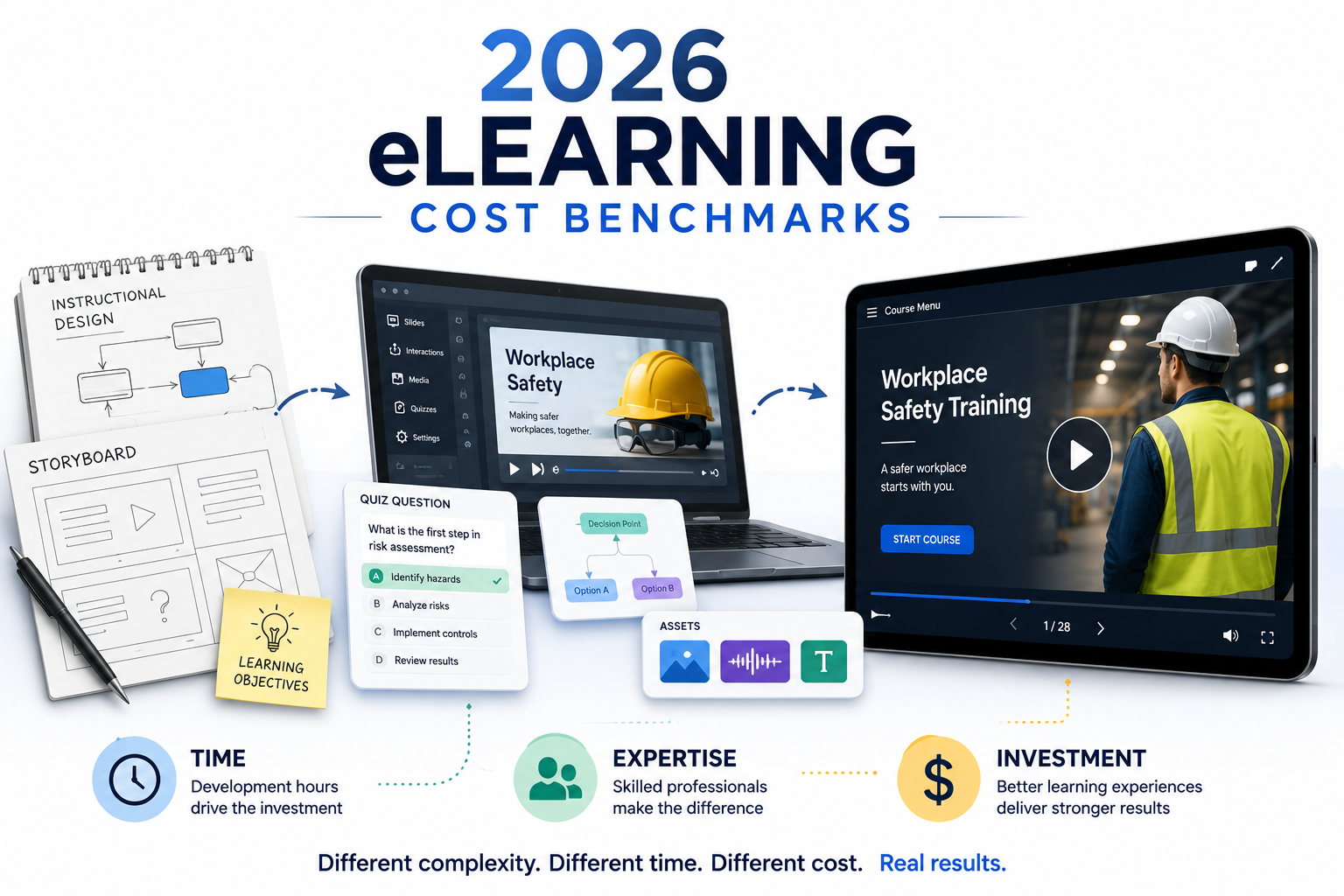
Budgeting for eLearning development is one of those things that looks straightforward until you actually try to do it. You ask three vendors for a quote, get three completely different numbers, and leave more confused than when you started.
That is not accidental. The eLearning development cost per hour varies enormously depending on complexity, who is building it, where they are based, and what "one hour of finished content" actually means in your context. A basic compliance module is not the same project as a branching scenario simulation, even if both end up being 45 minutes long.
This guide breaks down what eLearning development actually costs in 2026, by complexity tier, by production model, and by what is typically included or left out of the numbers you will see quoted. If you are trying to build a realistic budget or decide whether to outsource or build in-house, this is the data you need.
Why eLearning Cost Estimates Are So Hard to Compare
Before getting into the numbers, it is worth understanding why cost benchmarks in this space are so inconsistent.
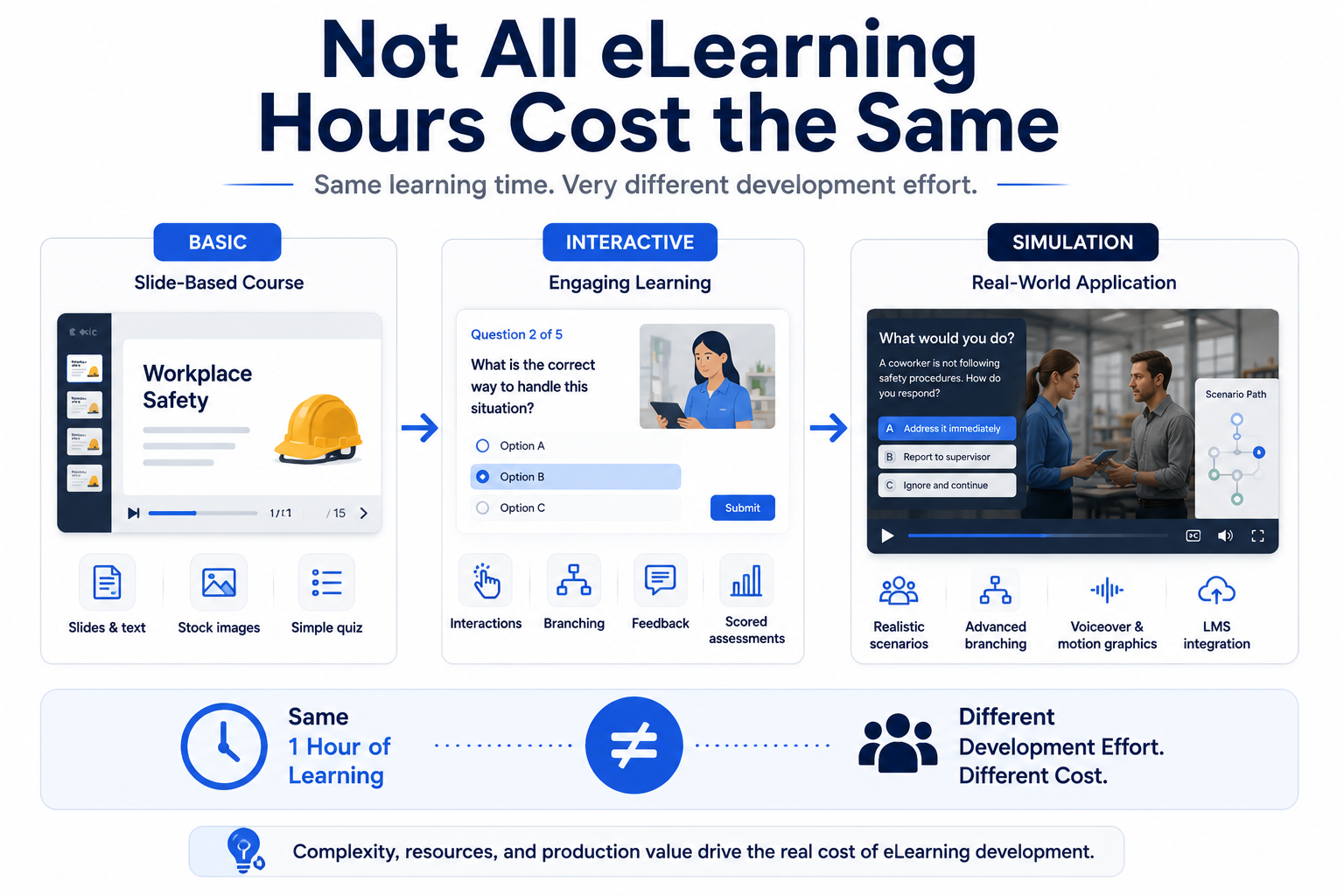
The most common unit of measure is cost per finished hour of instruction. But that number hides a lot. A finished hour of basic slide-based content takes fundamentally less effort than a finished hour of scenario-based learning with custom branching, voiceover, motion graphics, and LMS integration. Quoting both as a flat eLearning development cost per hour, without qualification, is like pricing a car without specifying whether it is a hatchback or an SUV.
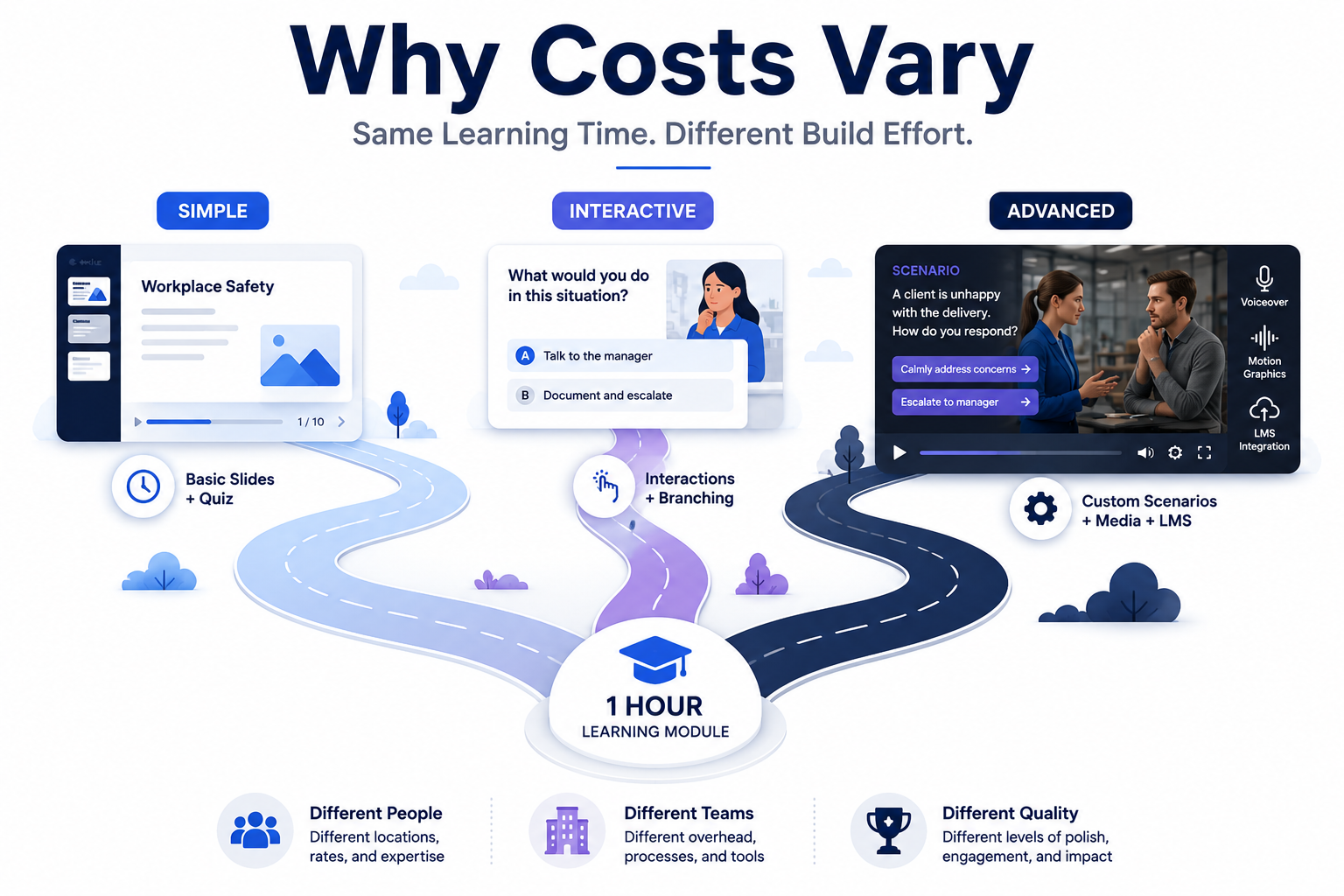
There is also the question of who is doing the work, and this is where Indian organisations have a real advantage. A specialist eLearning team in India will quote very differently from a boutique agency in the UK or an enterprise vendor in North America. Indian and offshore teams typically deliver the same quality of work at a fraction of Western rates, often a third or less, which is exactly why so much global eLearning production is now built in India. That is not undercutting; it reflects genuinely different cost structures while the output quality stays on par.
What follows are real-world ranges for the Indian market in 2026, drawn from current India eLearning pricing data alongside global benchmarks reported by the Association for Talent Development (ATD) and the Learning Guild, plus hands-on production experience. For context, comparable work from US or Western European agencies typically costs three to four times these figures, so if you are comparing an Indian quote against a Western one, expect the gap to be large. The numbers below should give you a reliable anchor for your planning conversations.
eLearning Development Cost by Complexity Tier
Tier 1: Basic eLearning, ₹40,000 to ₹60,000 per Finished Hour
Development time: 80 to 150 hours per finished hour.
This is the most common format for compliance training, policy updates, product knowledge, and onboarding content. It typically includes a slide-based structure (built in Rise, PowerPoint-to-SCORM, or similar), static graphics and stock imagery, text-based or simple multiple-choice assessments, basic narration (text-to-speech or simple voiceover), and SCORM packaging for LMS delivery.
At this tier, the content is functional and learner-friendly, but it is not doing anything complex from a design standpoint. If your goal is to move information efficiently and track completion, Tier 1 gets the job done at the lowest cost point.
Where costs climb within this tier: custom graphics, branded templates built from scratch, or content that requires heavy subject-matter-expert (SME) involvement and multiple revision cycles.
Tier 2: Intermediate eLearning, ₹60,000 to ₹1,20,000 per Finished Hour
Development time: 150 to 250 hours per finished hour.
This is where most organizations land when they want something more than a click-through module but are not yet investing in full custom production. Tier 2 content typically includes custom interactions and branching (built in Storyline or Captivate), scenario-based elements with decision points, professional voiceover recording, custom or semi-custom visual design, animations beyond basic fades, and knowledge checks with feedback loops.
The instructional design work at this tier is more involved. You are not just converting content into slides. You are structuring experiences that ask learners to make decisions, apply knowledge, and receive meaningful feedback. That takes more time, more expertise, and more back-and-forth with SMEs.
This tier suits role-specific skills training, sales enablement, customer service training, and any content where behaviour change, not just awareness, is the goal.
Tier 3: Complex eLearning, ₹1,20,000 to ₹2,50,000+ per Finished Hour
Development time: 250 to 400+ hours per finished hour.
Tier 3 is reserved for content that demands high production quality, complex functionality, or both. This includes fully custom branching simulations, software or systems training with click-through demonstrations, game-based learning, 3D or immersive scenario design, custom character animation, and integration with external systems beyond a standard LMS.
At this level, you are often working with a full production team: instructional designer, visual designer, developer, voiceover talent, project manager, and QA. The hours add up quickly, and rightly so. This is high-value content designed to drive measurable performance outcomes, not just completion rates.
Tier 3 investment makes sense for onboarding programs at scale, technical or safety-critical training, and flagship learning experiences where quality directly affects business outcomes.
eLearning Development Cost by Production Model
The complexity tier tells you what the content costs to produce. The production model tells you who produces it and how that shifts the number.
In-House Team: ₹800 to ₹2,500 per Development Hour (Fully Loaded)
Building content in-house feels cheaper because salaries do not look like vendor invoices. But once you account for salary, benefits, software licenses, management overhead, and the ramp-up time for new hires, the effective cost per development hour is often higher than it appears.
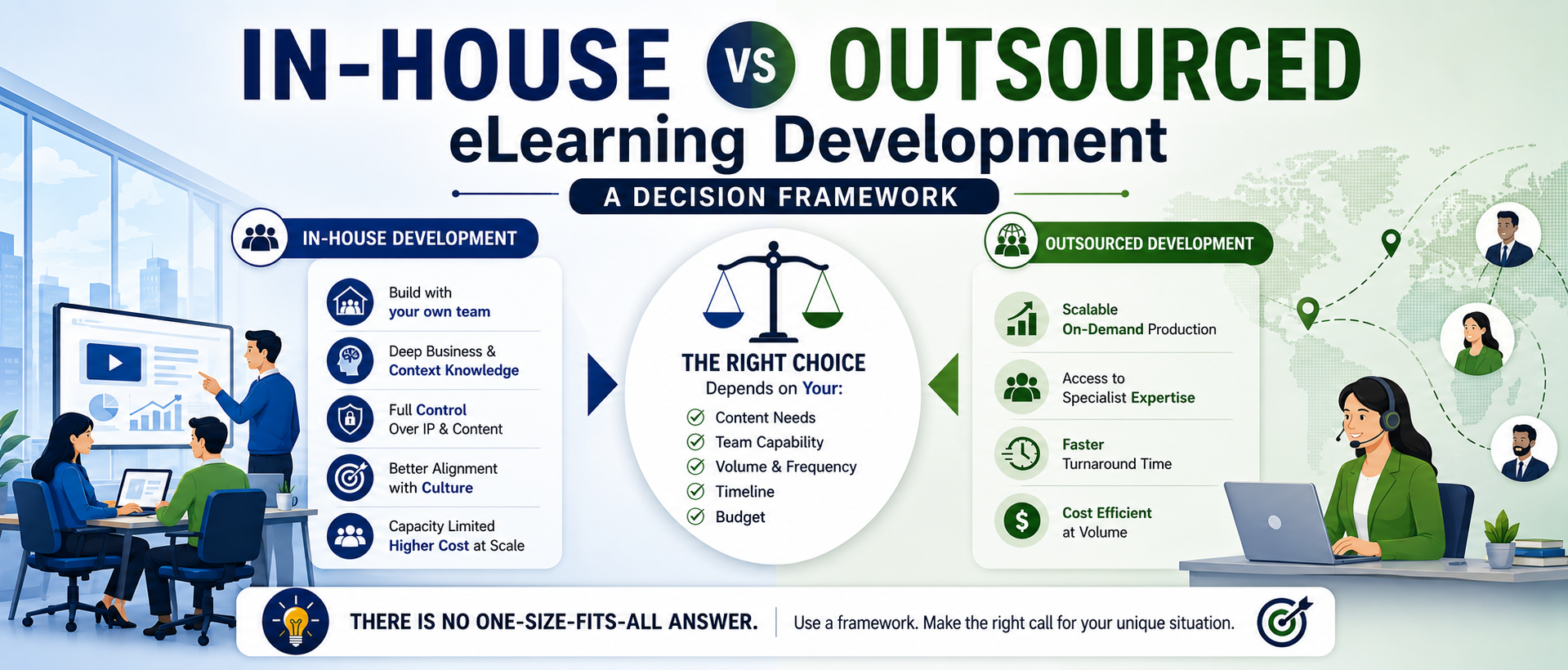
The advantage is control and institutional knowledge. In-house teams build expertise in your content, your brand, and your systems over time. The disadvantage is fixed capacity. When demand spikes, you either slow down or scramble. If you are weighing this trade-off seriously, our full breakdown of in-house vs outsourced eLearning development walks through the six variables that should drive the decision.
Freelance Instructional Designers: ₹700 to ₹3,000 per Hour
Freelancers offer flexibility and can be cost-effective for defined, contained projects. The range is wide because experience, location, and specialization all factor in heavily. A senior designer with 10 years of Storyline experience and a healthcare-compliance background will quote very differently from a generalist building their portfolio.
The risk with freelancers is scope management. Without a project manager coordinating the work, timelines and revision cycles drift. Freelancers also typically cover one discipline, so for a full production project, you may need to coordinate several yourself.
eLearning Agencies: ₹1,500 to ₹5,000 per Hour, or Fixed Project Pricing
Agencies bring a full team under one roof: instructional design, visual design, development, voiceover coordination, and project management. For complex projects or organizations without in-house L&D expertise, that coordination value is real.
The trade-off is cost and speed. Agency projects usually involve more structured discovery, more formal review cycles, and longer timelines than a freelancer or an AI-assisted partner. For landmark content that will live for years, that process has value. For fast-turnaround or high-volume needs, it can feel like too much overhead. Vetting matters enormously here, and our guide on how to choose an eLearning development company covers the red flags to watch for in pricing and scope.
AI-Assisted Production (with Instructional Design Oversight): ₹500 to ₹1,800 per Hour
This is the model that has changed the cost equation most significantly across 2025 and 2026. AI-assisted production uses generative AI platforms to handle the high-volume, repeatable parts of development: first-draft scripting, assessment generation, structure and outline, and localization. A human instructional designer then reviews, refines, and ensures the content is genuinely aligned to learning outcomes.
The result is production at Tier 1 and Tier 2 quality for a fraction of the traditional cost per hour, and at a speed traditional models cannot match. It is not right for every project; complex custom simulations still require significant human development. But for organizations producing high volumes of standard-to-intermediate content, this has become the most cost-efficient path that does not sacrifice quality. We cover how to do it safely in our guide to scale eLearning production with AI without losing quality.
What Is Usually Not Included in the Quoted Price
This is where budget surprises come from. When you get a quote, make sure you understand what is and is not covered.
Instructional design and storyboarding. Some vendors quote "development only" and assume you provide a complete storyboard. Others include design in their rate. Clarify upfront.
Voiceover and audio production. Text-to-speech is often included. Professional human voiceover is usually a separate line item, ranging from ₹8,000 to ₹25,000 per finished hour of audio, depending on talent and studio.
Graphic design and custom illustrations. Stock imagery is usually included. Custom illustrations, branded characters, or original graphic design are typically quoted separately.
SME time and review cycles. The quoted price covers development time. It does not cover the hours your subject-matter experts spend reviewing content, giving feedback, or attending workshops. In complex subjects, SME time is a high hidden cost.
Revisions beyond the agreed scope. Most vendors build one or two revision rounds into their quotes. If your review process involves multiple stakeholders with conflicting feedback, revision costs compound quickly.
LMS setup and publishing. Most vendors deliver a SCORM package. Uploading it, setting completion rules, assigning learners, and troubleshooting LMS issues is typically your team's job unless you negotiate managed services.
Translation and localization. If you need more than one language, add 25 to 40 per cent per language for professional translation, plus time for layout fixes caused by text expansion.
A Realistic Budget Framework for 2026
Here is how to turn these numbers into a budget that survives contact with reality.
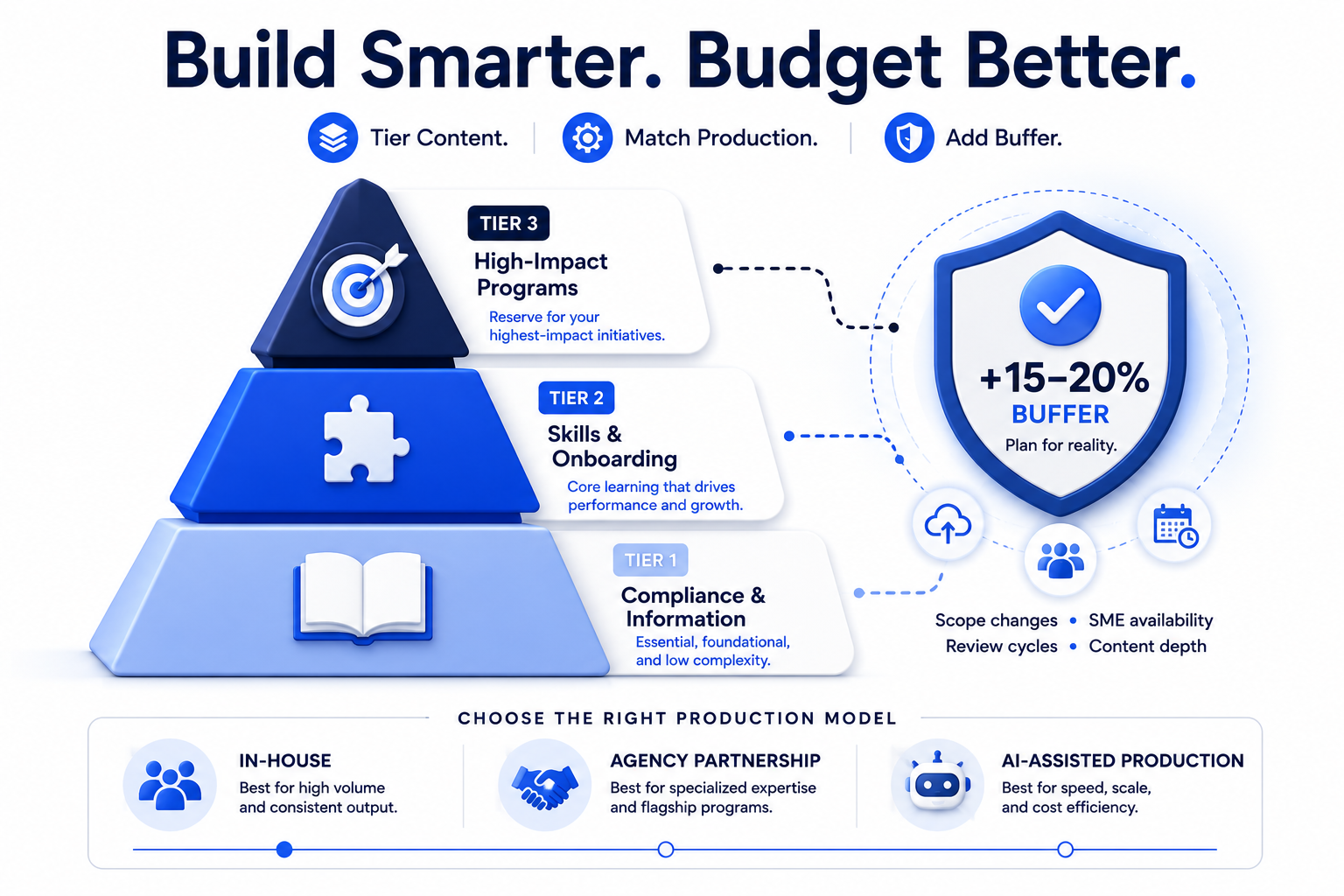
Start by categorizing your content. Not everything needs to be Tier 2. Many organizations default to moderate interactivity for everything because that is what their toolset supports, not because every piece requires it. Audit your needs and assign a tier to each type. Compliance refreshers and informational modules can usually sit at Tier 1. Role-specific skills training and onboarding deserve Tier 2. Reserve Tier 3 for your highest-impact programs.
Then choose a production model that matches your volume and velocity. If you are producing 20 or more hours of new content per year, the math on in-house or AI-assisted production looks very different from project-by-project outsourcing. If you have one or two flagship programs a year, a quality agency relationship makes more sense.
Finally, build in a contingency buffer of 15 to 20 per cent. eLearning projects almost always involve scope discovery: content more complex than it looked, SME availability that slows things down, or review cycles that expose gaps in the source material. Budget for reality, not the optimistic version.
How Creaitify Fits Into This Picture
Most eLearning development cost problems are not really about price. They are about the gap between what organizations need to produce and what their current model can sustainably deliver.
Traditional production methods are not fast or cheap enough for the volume of content modern L&D teams are expected to produce. Pure AI tools without instructional design oversight produce content that looks right but does not work. The hybrid model, AI-powered production guided by genuine instructional design expertise, closes that gap.
Creaitify's Content Production Outsourcing (CPO) service is built around exactly this model. You get the speed and cost efficiency of AI-assisted production without sacrificing the instructional quality that makes content worth completing. Whether you need to build a curriculum from scratch, modernize an existing library, or spin up localized content at scale, the approach is the same: AI handles the production load, and experienced instructional designers ensure the learning outcomes are real.
If you want to understand what this model would cost for your specific content needs, the clearest next step is a conversation.
Learn more: In-House vs Outsourced eLearning Production