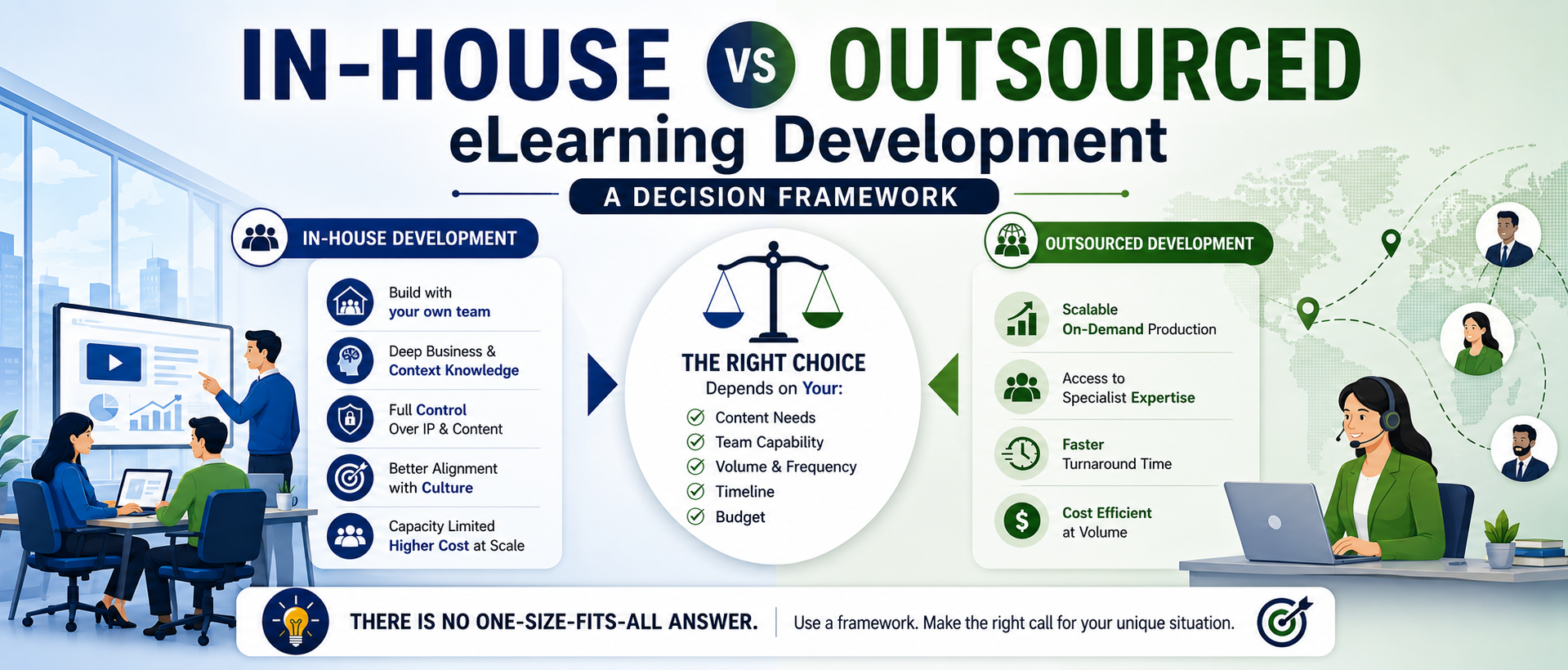
If you're reading this, you've probably already decided you need outside help. You've worked out the in-house math, or your roadmap has outgrown your team, or your last vendor relationship didn't end well, and you're looking for someone better. (If you haven't worked through that decision yet, start with our piece on in-house vs outsourced eLearning development, it'll save you a procurement cycle.)
So now the actual question. Who do you hire?
This is where most buyers get hurt. The eLearning development market is enormous, fragmented, and stuffed with vendors who all sound roughly the same in a pitch deck. Twenty years in, I can tell you the gap between the best and the worst providers in this space is wider than in almost any industry I know. Two companies will quote the same scope at the same price and deliver outcomes that are not in the same universe. And you usually can't tell which is which until you're three months into the engagement.
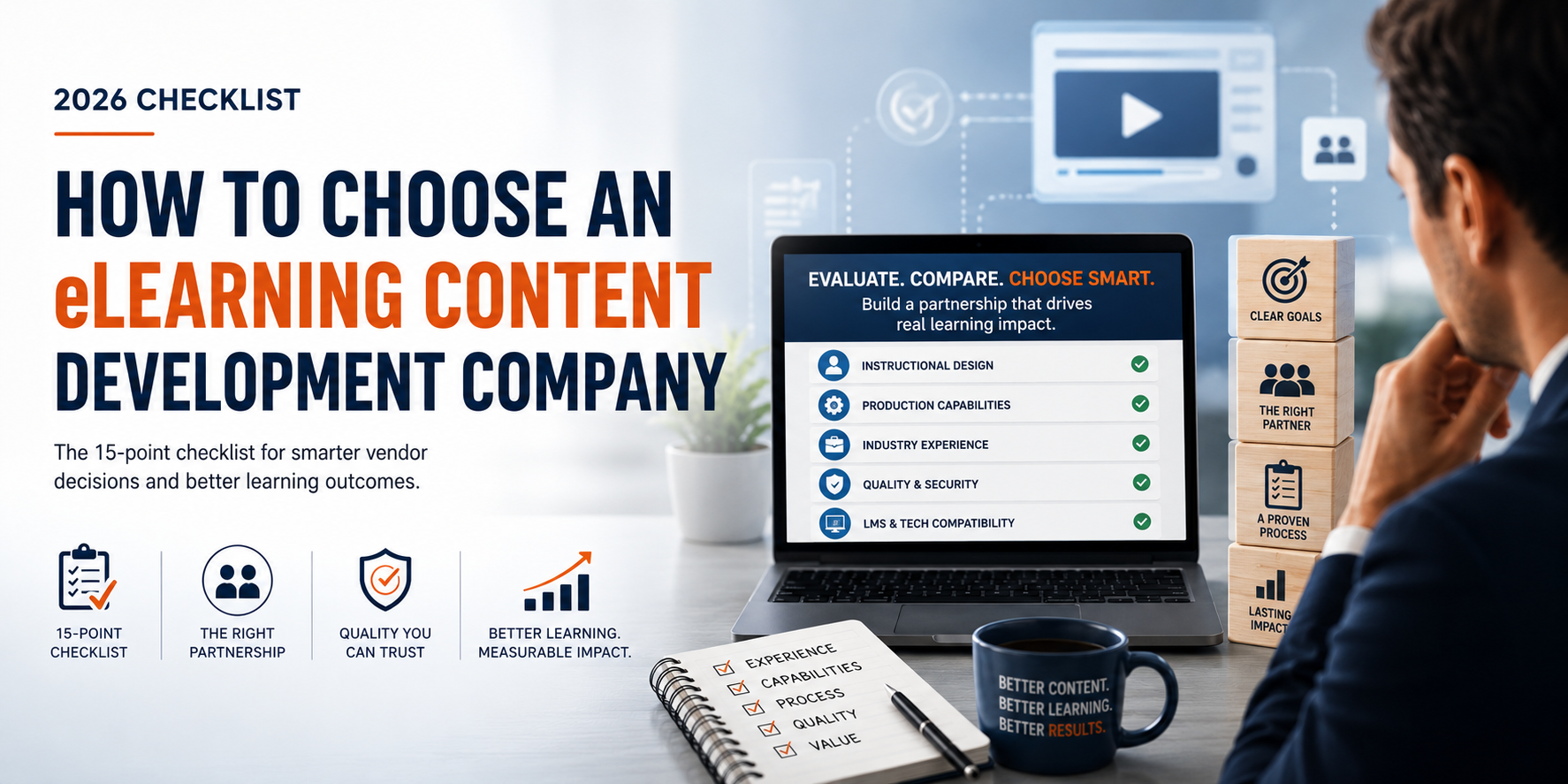
The point of this guide is to flatten that risk. Below is a 15-point checklist I've refined over years of watching procurement teams make this call well and badly. Use it. Print it. Take it into your vendor calls. It's the same checklist I'd use if I were buying eLearning development services for my own organization.
Before the Checklist: The One Mindset Shift That Matters
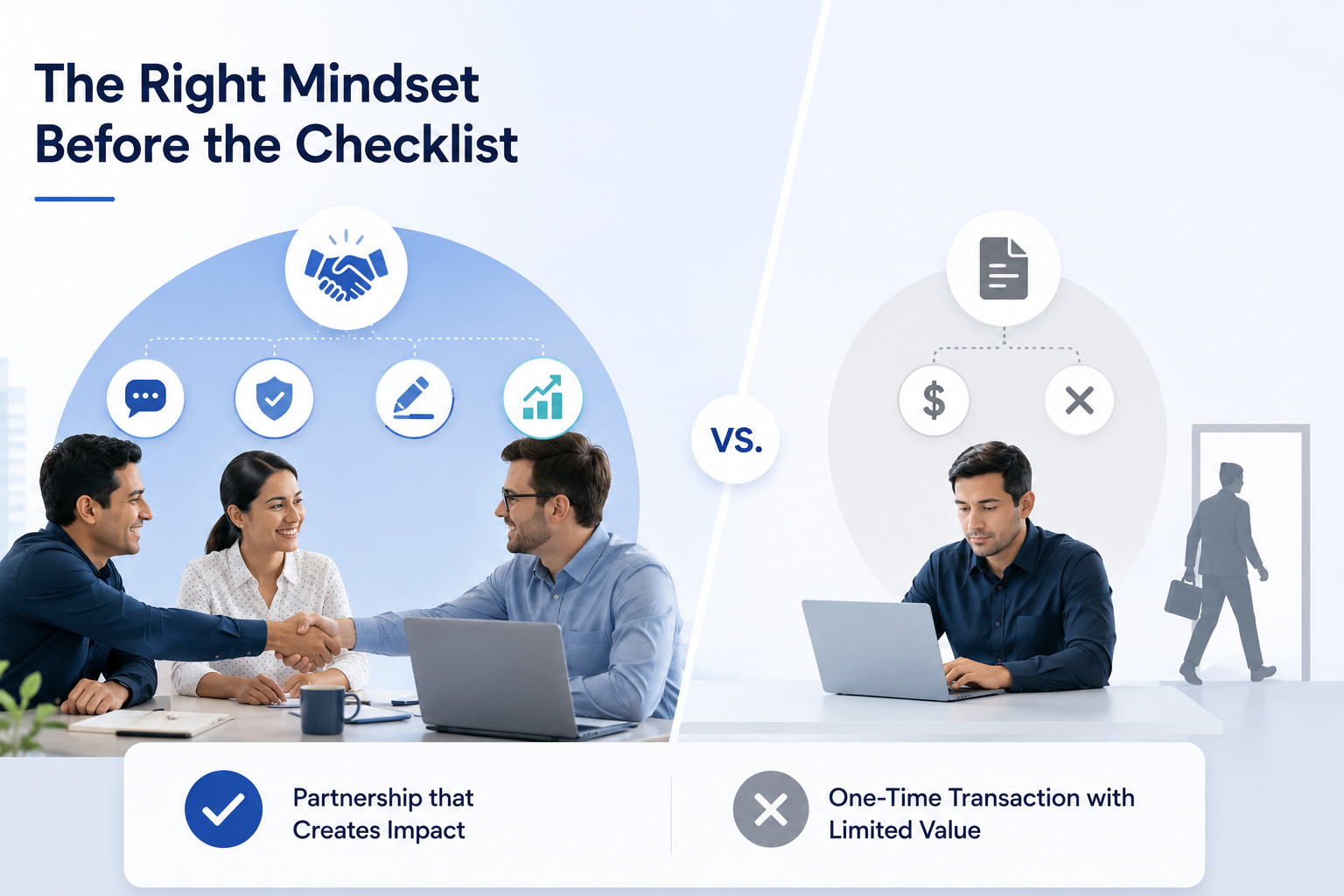
Before you score a single vendor, get this clear in your head: you are not buying content. You are buying a partnership that produces content.
This sounds like a semantic point. It isn't. The vendors who deliver consistently well over multi-year engagements are the ones you can have real conversations with, push back on briefs, raise concerns, and redesign mid-flight when a stakeholder changes their mind. The vendors who produce one-shot work and disappear are usually the cheapest on the spreadsheet and the most expensive over time.
Score for the relationship, not just the deliverable. Now, the checklist.
The 15-Point Checklist for Choosing an eLearning Content Development Company
1. Production Capability Across the Full Stack
Ask what they can do in-house versus what they subcontract. A real production partner has instructional design, scriptwriting, visual design, development (Articulate, Storyline, Rise, Captivate, HTML5, whatever you need), voiceover, localization, and QA under one roof or with tightly integrated long-term partners.
Why this matters: studios that subcontract major capabilities get expensive fast on revisions. Every change has to be coordinated across two or three external teams. Things slip. Your project manager becomes their project manager.
Red flag: vague answers like "we have a network of partners" without specifics on who does what.
2. Instructional Design Methodology
Ask them to explain their instructional design approach in three minutes. If they default to "we follow ADDIE" and stop there, push harder. ADDIE is a project management model, not an instructional design methodology. What you want to hear is a clear point of view on how they think about learner behavior change, references to action mapping, scenario-based design, cognitive load principles, Bloom's taxonomy applied rigorously, or their own documented framework.
Red flag: generic methodology answers, no documented framework, IDs who can't articulate why one design choice beats another.
3. Portfolio Depth in Your Industry or Content Type
Everyone's portfolio looks impressive on a website. Press them for specifics. Ask for three projects in your industry or content category, with named clients, named challenges, and measurable outcomes if available. Ask to speak to one of those clients as a reference.
If they've done compliance for banks, ask about compliance for banks. If you need leadership content, ask for leadership content samples. General competence isn't the same as relevant competence.
Red flag: portfolio shown but reluctance to share specifics, name clients, or arrange references.
4. Quality of the People Actually Doing Your Work
This is the single biggest predictor of project quality, and the easiest one to skip over. The senior people in the pitch meeting are almost never the people producing your modules. Ask directly: who will be on my project? Show me their CVs. How many years of ID experience do they have? Who's the project lead?
A good provider will walk you through the actual team. A weak one will tell you, "We'll assign the right people" without committing.
Red flag: vague answers about staffing, refusal to name the project team, or experienced senior staff in the pitch with junior staff doing the work.
5. AI Capability and Workflow Maturity
In 2026, this is no longer optional. Ask how they use AI in their production pipeline. Listen for specificity. A serious provider will describe where AI accelerates production (drafting, voiceover, assessment generation, localization), where humans remain essential (strategy, quality control, complex design), and what their quality safeguards are against AI failure modes like hallucinations and generic output.
"We use AI everywhere" is as bad an answer as "we don't use AI." Both signal a lack of maturity.
Red flag: vague claims about AI, or an inability to explain their quality control process for AI-generated content.
6. Security, Compliance, and IP Posture
Ask for written documentation of their information security posture. SOC 2 Type II if you're a regulated buyer. ISO 27001 if you're international. Specific data residency commitments if you have geographic constraints. Explicit clauses on IP assignment, NDA standards, and increasingly important no-training-on-your-data agreements if AI is involved.
A serious vendor has this paperwork ready and shares it without flinching. A weak one stalls.
Red flag: delays in producing security documentation, vague answers on IP, and no clarity on AI data handling.
7. Localization Depth - Not Just Translation
If you operate across multiple geographies, this is critical. Ask specifically: Do you handle linguistic translation only, or do you do cultural adaptation of scenarios, examples, and underlying assumptions? Ask for examples of localized projects where scenarios were changed, not just translated. Ask which languages they have native-speaker review on, and which they handle through machine translation plus light review.
Localization is where many global eLearning projects quietly fail. The difference between a vendor who translates and a vendor who localizes is enormous.
Red flag: treating localization as a translation step, no native-speaker review in critical languages.
8. Sample Production Process - Not Sample Decks
Ask them to walk you through their production process for a hypothetical 30-minute module. Brief to final delivery. What are the stages? What are the review gates? What does the client (you) see at each stage? How are revisions handled?
You're listening for two things. First, that the process is mature and standardized, not made up on the fly for each client. Second, that you have meaningful approval points, not just a final delivery you either accept or reject.
Red flag: improvised-sounding processes, no defined review gates, or a process that gives you visibility only at the end.
9. Pricing Transparency and Change Order Policy
Ask for a sample pricing structure. Hourly? Per finished hour of content? Per module? Hybrid? Each model has trade-offs, and the right answer depends on your situation, but the transparency is what you're testing.
Specifically, ask how change orders work. What's in scope, what triggers an additional charge, and how are mid-project scope changes priced? The vendors who get this conversation out of the way upfront are the ones who don't nickel-and-dime you later.
Red flag: vague pricing, suspiciously low initial quotes (they're usually betting on change-order revenue), or evasive answers about scope boundaries.
10. Project Management Approach
A great instructional design team with weak project management still produces missed deadlines and frustrated clients. Ask who your day-to-day point of contact will be, how often you'll have status meetings, what reporting cadence and format you'll get, and what their escalation process looks like when things go wrong.
Look for a named PM, a defined cadence, written reporting, and a clear escalation path. Anything less is a risk.
Red flag: no named project manager, no defined reporting structure, no clear escalation path.
11. Volume and Surge Capacity
Ask: What's the maximum monthly output you can deliver without compromising quality? What's your typical lead time? How quickly can you scale up if I have a surge?
You need a partner whose capacity comfortably exceeds your demand. A vendor running at full capacity will hit quality problems the moment your urgent request lands.
Red flag: vendors who claim unlimited capacity (no one has it) or who clearly don't have the bench strength to handle surges.
12. Standards Compliance - SCORM, xAPI, AICC, WCAG
Verify, don't assume. Ask which standards they produce by default, which they can produce on request, and whether they have working knowledge of accessibility standards (WCAG 2.1 or 2.2, depending on your requirements). Ask for a sample SCORM package or xAPI implementation if technical compliance is critical for your LMS.
For accessibility specifically, ask how they handle alt text, closed captions, audio descriptions, keyboard navigation, and screen reader compatibility. A vendor who treats accessibility as an add-on at the end is the wrong vendor.
Red flag: vague answers on technical standards, accessibility treated as optional, no sample technical packages available.
13. References - Active and Recent
Ask for three references. Not curated case studies, actual phone numbers of clients you can call. At least one should be a current client (still working with them), and at least one should be from a project completed in the last twelve months.
When you call, ask specific questions. What broke during the project, and how did the vendor handle it? How were change requests managed? Would they hire them again? Would they hire the same project team again?
Red flag: reluctance to share recent references, old references only, references that give suspiciously uniform answers.
14. Cultural and Communication Fit
This one's softer, but it matters. You're going to be in weekly meetings with these people for the duration of your engagement. Pay attention to how they communicate in the pitch. Do they ask good questions? Do they push back on your brief when something seems off? Do they listen, or do they wait to talk?
The vendors who challenge your thinking in the sales process will be the ones who challenge your thinking when it matters, when a stakeholder is pushing a design choice that will hurt learners, or when a deadline is unrealistic, and someone needs to say so.
Red flag: vendors who agree with everything, ask no probing questions, or speak only in marketing language.
15. Pilot Project Willingness
Ask if they'll do a paid pilot project before a larger engagement. A confident, mature vendor will say yes immediately. A less confident one will resist, push for a full contract upfront, or offer unattractive pilot terms.
A pilot is the single best risk-reduction tool in your toolkit. One small project, say, a 15 to 30 minute module, tells you more about a vendor than ten pitch meetings. Use it.
Red flag: unwillingness to pilot, all-or-nothing contract terms, suspiciously expensive pilot pricing.
The Cheaper Vendor Almost Always Costs More
I've seen this pattern enough times that I'd put real money on it.
A buyer gets three quotes. One is significantly cheaper than the other two. The buyer chooses the cheap one, reasoning that the deliverable is similar and the budget is tight. Six months later, they're either re-doing the work with one of the original two or they've inherited an LMS full of content that nobody trusts.
Cheap vendors don't lose money on their projects. They make money the way budget airlines make money by stripping things out. Less senior staff. Less rigorous review. Less testing. Less revision time built in. Aggressive change orders. The deliverable looks the same on the surface. It is not the same product.
This doesn't mean expensive is always better. It absolutely doesn't. But when you see a quote that's noticeably below the others, ask hard questions about what's been stripped to hit that number. Sometimes the answer is "operational efficiency." Sometimes the answer is "things you'll regret in month four."
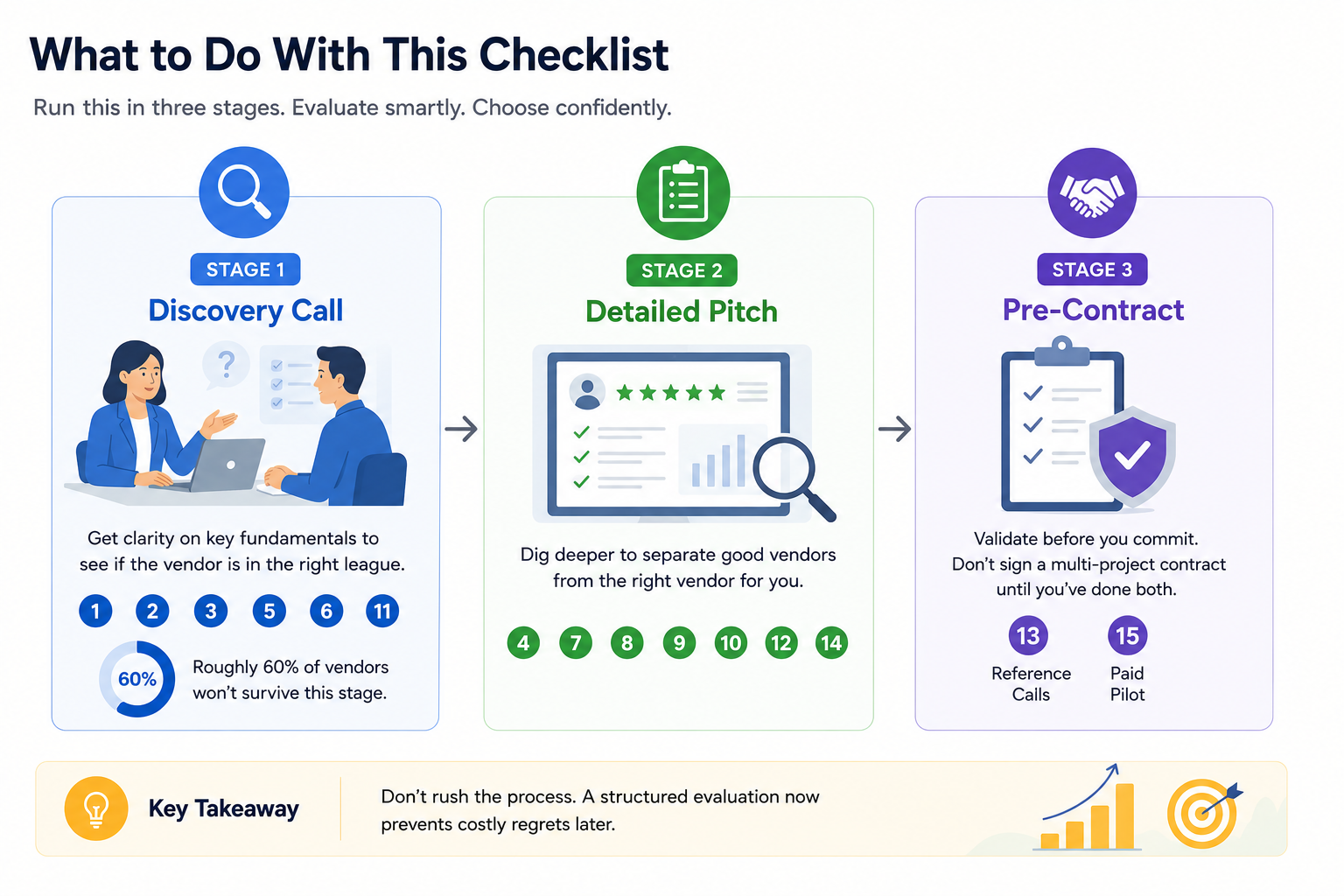
Three-stage vendor evaluation checklist for choosing the right eLearning content development company.
What to Do With This Checklist
Don't try to score every vendor on all 15 points in your first call. You won't get useful answers, and the conversation will feel like an interrogation. Instead, run this in three stages.
Stage 1 (Discovery call): Get clarity on points 1, 2, 3, 5, 6, and 11. These tell you whether the vendor is even in the right league. Roughly 60% of vendors won't survive this stage.
Stage 2 (Detailed pitch): Dig into points 4, 7, 8, 9, 10, 12, and 14. This is where you separate good vendors from the right vendor for you.
Stage 3 (Pre-contract): Validate with points 13 and 15. Reference calls and a paid pilot. Don't sign a multi-project contract until you've done both.
Most procurement processes I see collapse stages 2 and 3, or skip stage 3 entirely. That's where post-contract regret comes from.
What the Best Vendors Do That Average Vendors Don't
After enough years of watching this play out, the patterns are predictable.
The best providers ask harder questions in the sales process than the average ones. They want to understand your learners, not just your scope. They push back on briefs that seem unclear. They tell you when something you've asked for won't work, and they offer alternatives.
The best providers have opinions. They have a documented design methodology. They have a point of view on AI. They have a position on what good learning looks like. They will not produce content they don't believe will work for your learners, even if you ask them to.
The best providers are slightly more expensive than the average, and significantly cheaper over the long term, because their work doesn't need to be redone.
The best providers want a long relationship more than they want this one contract. You can feel that in the way they sell.
Make the Decision Well
Choosing an eLearning content development company is one of the higher-leverage decisions in an L&D operating model. The right partner compounds every project gets better as they learn your context. The wrong partner taxes every project, requiring the same battles all over again.
The 15 points above will get you to a shortlist of genuinely capable vendors. The pilot project will tell you which of them is right for you. Don't shortcut the process. The cost of a six-week selection cycle is trivial compared to the cost of a wrong vendor signed for two years.
If you'd like to see how we'd answer the 15 points for your specific situation, get a custom proposal, and we'll walk you through our methodology, team, samples, references, and pilot terms point by point. We're confident in the answers. If we're not the right fit, we'll say so.
You can also download our Vendor Evaluation Checklist, a one-page, scoreable version of the 15 points above, ready to take into your next vendor call.