I've sat in this meeting more times than I can count.
A Head of L&D, usually with a fresh roadmap from leadership, asks the same question in some version. "Should we build this in-house or send it out?" Sometimes they've already made up their minds and they want me to validate it. Sometimes they genuinely don't know. Sometimes they've tried one approach, gotten burned, and are looking for permission to try the other.
After twenty years of watching teams make this call, I'll tell you what I've learned: there is no right answer. There's only a right answer for your specific situation, and the situation has more moving parts than most decision-makers initially realize.
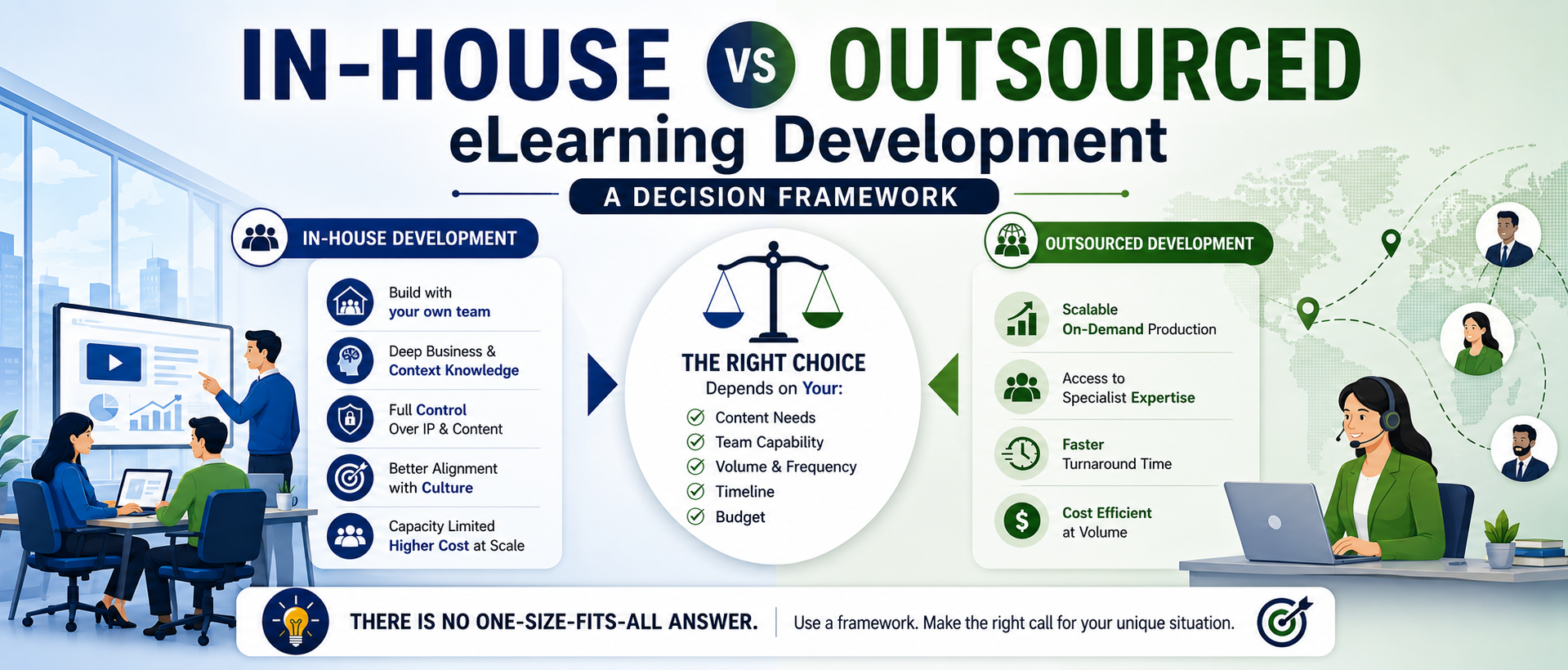
Most articles you'll find on this topic will give you a tidy pros-and-cons table and call it a day. That's not useful. The real question isn't "which model is better," it's "which model fits us, given our content mix, our team, our volume, our timeline, and our budget?" And that question deserves a real framework, not a table.
So let's do this properly. I'll walk you through what each model actually looks like in practice, where each one quietly fails, and then give you a decision framework you can apply to your own situation today. By the end of this, you should know which way you're leaning and why.
Let's Be Clear About What We're Actually Comparing
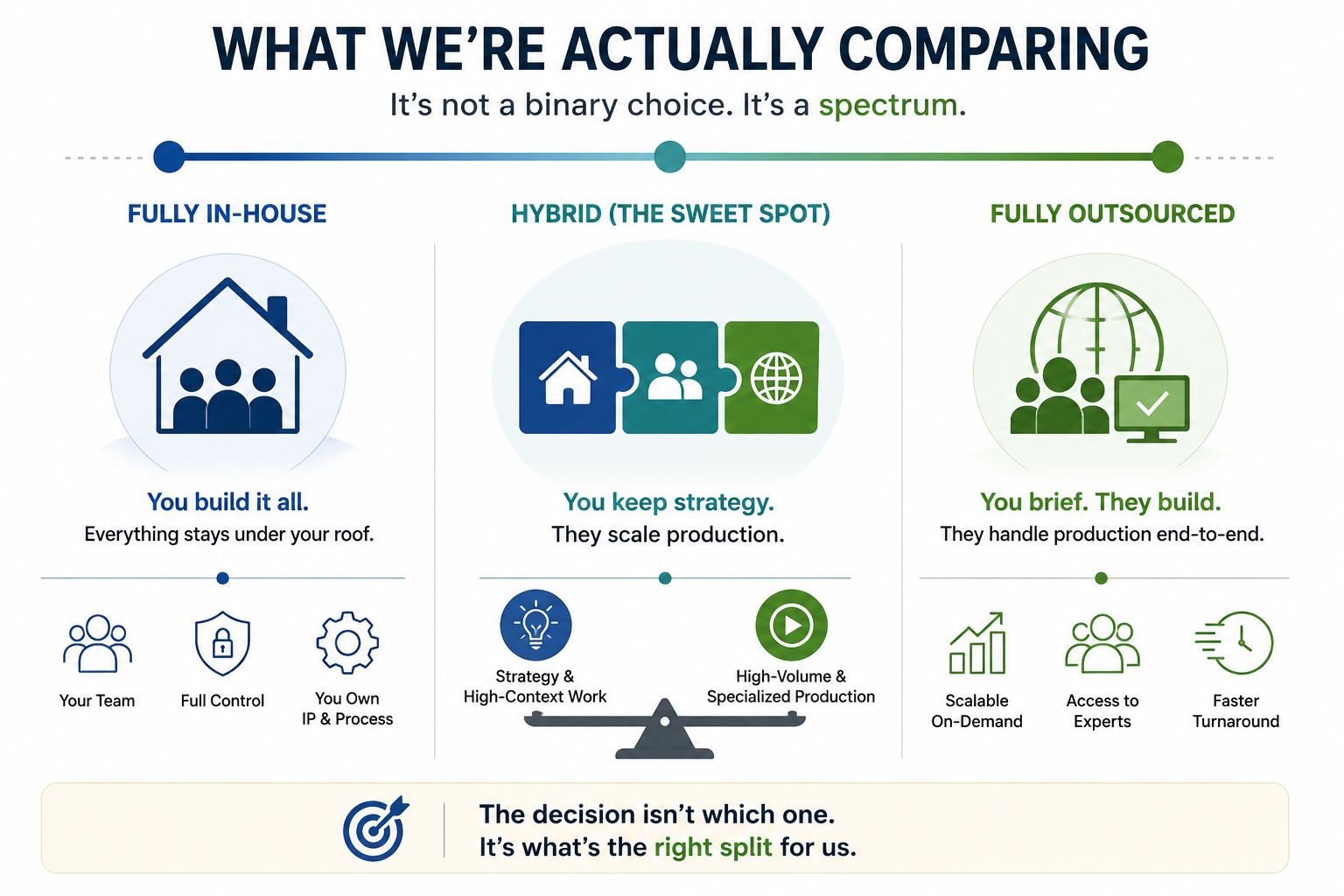
Before we get into the framework, we need to be honest about the options. Because "in-house vs outsourced" is not actually a binary choice. It's a spectrum, and the most successful L&D teams I work with operate somewhere in the middle.
Fully in-house means you employ instructional designers, scriptwriters, visual designers, developers, voiceover talent (or use a tool), QA, and project managers. Everything stays under your roof. You own the talent, the IP, and the production line.
Fully outsourced means you give a vendor a brief, a budget, and a timeline, and they deliver finished modules. Your team handles strategy, vendor management, and approvals. They handle production.
Hybrid, and this is where most mature L&D functions land, means you keep strategic and high-context work in-house, and outsource the high-volume or specialized production work. Examples: in-house IDs design the learning architecture, and an outsourced partner produces the modules. Or in-house team handles flagship leadership programmes, vendor handles compliance refreshes and product training.
The decision isn't really which one. It's what's the right split for us, and that's what the framework is going to help you figure out.
The Honest Case for In-House Development
I'll start with in-house because it tends to get romanticized, and I want to be clear about what you actually get when it works, and what you're signing up for.
What in-house genuinely gives you: Deep institutional knowledge. Your IDs understand your business, your products, your culture, your sacred cows. They know which SMEs are responsive and which ones disappear for three weeks. They know your brand voice without being briefed. They can pivot in a day when a product launch shifts. That contextual depth is real and it's hard to replicate.
You also keep IP and proprietary methodology entirely under your roof, which matters if you've built a unique pedagogical approach or work with sensitive content (financial services, defense, healthcare).
What in-house actually costs you, and where it quietly fails: Capacity is the single biggest problem. A fully-loaded in-house team says, two IDs, one visual designer, one developer, half a project manager costs somewhere between $400,000 and $600,000 a year, fully loaded, in most markets. That team can produce 30 to 50 hours of high-quality finished learning a year. Maybe more with AI augmentation, but let's stay grounded.
The math gets uncomfortable fast. If your annual demand is 40 hours of learning, an in-house team makes sense. If it's 120 hours, you either build a much bigger team (with all the management overhead that brings) or you accept that you can't actually deliver what's being asked.
The other quiet failure: skill gaps. Your in-house team will be excellent at the work they do regularly and weaker at the work they don't. If you suddenly need a high-end animated explainer, or a complex simulation, or a Spanish localization, your team probably can't deliver it at the quality level you'd want. You can hire freelancers, but now you're managing an extended team without the systems most production studios have.
In-house works when your content volume is predictable and moderate, your content depth requires deep business context, and your strategic case for owning the capability is strong.
The Honest Case for Outsourced Development
Now the other side. And again, I want to be specific about what works and where it breaks.
What outsourcing genuinely gives you: Scale, on demand. A good production partner can flex from 10 hours to 100 hours of monthly output without you hiring anyone. They have specialists, animators, instructional designers, developers, localization specialists, and voiceover talent already in place. You're buying access to a fully-built production line, not building one yourself.
You also get cost efficiency at volume. A well-run partner can produce a 60-minute custom module for $8,000 to $20,000, depending on complexity. Producing that same module in-house, when you factor in fully-loaded team costs, often runs higher per finished hour, particularly if your team is also doing strategy work and isn't dedicated to production.
And honestly, you get speed. A good partner has templates, workflows, asset libraries, and a production muscle that a small in-house team simply can't match.
Where outsourcing quietly fails: Context. The vendor doesn't know your business, your culture, or your stakeholders. Every project starts with a context dump, and if you don't do that well, you'll get generic output that needs three rounds of revision. The teams that get the most from outsourcing have invested seriously in vendor onboarding, brand guides, style guides, sample content, stakeholder maps, and the works.
IP and confidentiality are the other concerns, especially in regulated industries. A good vendor handles this with proper agreements and security controls. A cheap vendor handles it with crossed fingers. Pick carefully.
The third quiet failure is communication overhead. Managing a vendor relationship is itself a job. Briefings, reviews, feedback loops, escalations if you don't have someone owning the vendor relationship full-time, things slip.
Outsourcing works when your content volume is high or variable, you need specialized capabilities you can't justify in-house, and you have someone internally who can own the vendor relationship properly.
What the In-House vs Outsourced Decision Really Hinges On
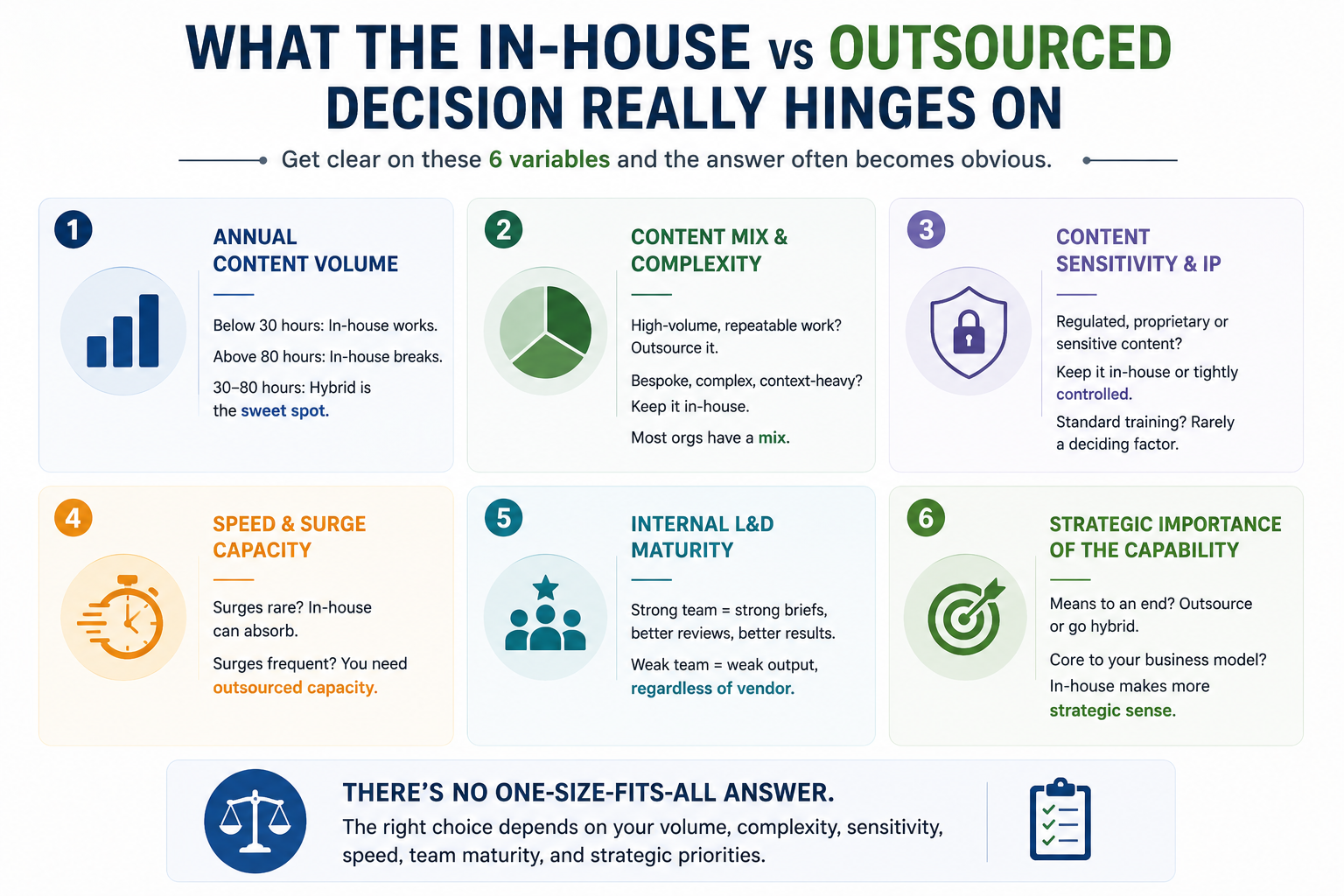
Forget the generic pros-and-cons lists for a moment. After two decades of watching this decision get made, I can tell you it actually hinges on six variables. Get clear on these six, and the answer often becomes obvious.
Variable 1: Annual Content Volume
This is the biggest single driver, and most teams underestimate it.
Below 30 hours of finished learning per year, a small in-house team works fine. Above 80 hours, in-house starts to break unless you scale headcount aggressively. Between 30 and 80 hours is the sweet spot for hybrid, keep a lean in-house core, outsource the surge.
Be honest about your volume. Look at last year's actual delivery, not the wishlist. Most teams I work with have a stated demand that's 1.5 to 2 times what they actually shipped.
Variable 2: Content Mix and Complexity
Not all eLearning is the same. A compliance refresh is fundamentally different from a custom leadership simulation.
If 70% of your content is high-volume, repeatable, template-able work (compliance, product updates, basic skills), outsourcing scales well. If 70% is bespoke, narrative-rich, context-heavy work (leadership development, culture change, complex change management), in-house tends to win.
Most organizations have a mix, which is exactly why hybrid models dominate.
Variable 3: Content Sensitivity and IP
Some content can go anywhere. Some content cannot.
If your content involves regulated data, proprietary methodology, defense applications, or genuinely sensitive cultural training, an in-house or a tightly-controlled hybrid is usually safer. If your content is standard corporate training, sensitivity is rarely the decisive factor.
Variable 4: Speed and Surge Capacity
How often do you get hit with urgent requests? Product launches, regulatory changes, M&A activity, leadership shifts?
If surges are rare, in-house can absorb them with overtime. If surges are frequent, you need outsourced capacity on standby; otherwise, you'll either miss deadlines or burn your team out trying not to.
Variable 5: Internal L&D Maturity
This one's uncomfortable but important. How strong is your internal team, honestly?
If you have experienced IDs who can write detailed briefs, manage vendor relationships, and review output critically, outsourcing works well. If your internal team is junior or under-resourced, outsourcing often produces poor results because nobody internally can guide the vendor or catch quality issues early.
I've seen this kill more outsourcing relationships than any vendor failure. Weak briefs and weak reviews produce weak output. The vendor gets blamed. The real problem was internal.
Variable 6: Strategic Importance of the Capability
Is building eLearning a strategic capability for your organization, or is it a means to an end?
For a corporate L&D function, it's almost always a means to an end. You want great learning experiences for your people; you don't need to be a content production studio. Outsourcing or hybrid makes sense.
For an EdTech company, a training provider, or a company whose business model includes selling learning content, content production is core. In-house typically makes more strategic sense, even at a higher cost.
The Decision Framework
Here's the framework I take L&D leaders through. Score yourself honestly on each variable. Then look at the pattern.
Variable | In-House Favored | Hybrid Favored | Outsourced Favored |
|---|---|---|---|
Annual content volume | Below 30 hours | 30–80 hours | Above 80 hours |
Content complexity | Mostly bespoke, high-context | Mixed | Mostly templated, repeatable |
IP / sensitivity | High | Mixed | Low to moderate |
Surge frequency | Rare | Occasional | Frequent |
Internal team maturity | Strong, senior | Mixed | Strong vendor management capability |
Strategic importance | Core to business | Important but not core | Means to an end |
If you land mostly in the left column, in-house is your model. If you land mostly to the right, outsource it. If you're scattered across the middle and most organizations are hybrid is the answer and the real question becomes what to keep in-house and what to outsource.
How to Design a Hybrid Model That Actually Works
Most of you reading this will land in the hybrid camp. So let me be specific about how to make a hybrid actually work, because done badly, you get the worst of both models: the overhead of an in-house team and the management complexity of a vendor relationship.
The hybrid model that consistently works follows a clear principle: keep strategy, context, and quality oversight in-house. Outsource production capacity.
In practice, that looks like:
In-house owns: Learning strategy, needs analysis, learning architecture, stakeholder management, brand and pedagogical standards, final quality approval, flagship content (the high-stakes, high-context modules), and vendor management.
Vendor owns: High-volume production, specialized capabilities (animation, simulation, localization), surge capacity, and template-driven content.
Your in-house team becomes a small group of senior IDs and a strong production manager. They design the experience, write the brief, manage the vendor, and own quality. The vendor brings the production muscle.
Here's the part most people miss: this only works if your in-house team has real seniority. Hybrid models break when junior in-house staff are managing experienced vendors. The vendor ends up driving decisions they shouldn't be driving. Invest in the in-house seniority, not the in-house headcount.
A Real Example of Each Model in Action
Let me ground this with three real scenarios I've seen play out.
Scenario one: A regional bank with 8,000 employees and a 3-person L&D team. Annual content demand: roughly 25 hours of finished learning, mostly compliance refreshes and product training. They tried building in-house. Couldn't keep up. Tried fully outsourced. Lost the contextual nuance that their compliance team kept flagging. Settled on a hybrid: in-house does briefs and final review, vendor produces. Output went up, team stress went down, compliance team got happier. Two years in, still working.
Scenario two: A global manufacturer with 45,000 employees and an 18-person L&D team. Annual content demand: 150+ hours across 9 languages. Fully in-house was never realistic. They run a hybrid with two outsourced production partners, one for standard content, one for high-end simulations. The in-house team focuses entirely on strategy and quality. Their per-hour cost is competitive, their output is high, and their team isn't burning out.
Scenario three: A fast-growing tech company with 1,200 employees and a 2-person L&D team. Annual demand: 40 hours, but variable and surge-driven. They tried hiring more in-house. Couldn't find good IDs fast enough. Moved to a fully outsourced model with a single dedicated vendor. Vendor learned their context over six months and now delivers near-in-house quality with full scalability. The in-house team became a 2-person learning strategy function. Works beautifully.
Three different organizations, three different models, all working. The fit was specific to each one.
What to Watch For When You Outsource
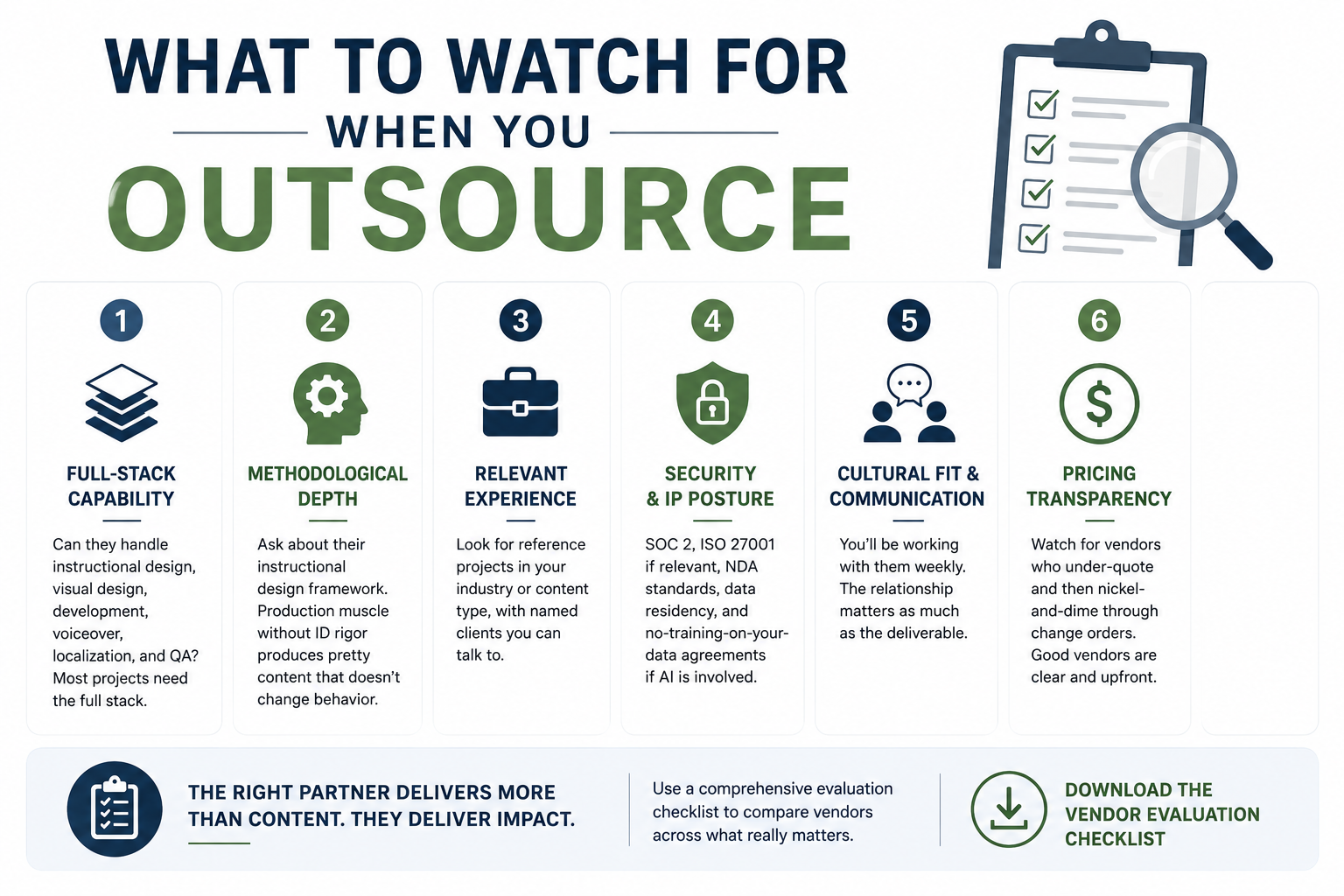
If you decide to outsource, fully or in a hybrid, the vendor selection matters more than people realize. Here's what to actually look for, beyond the standard portfolio review.
Production capability across the full stack. Can they do instructional design, visual design, development, voiceover, localization, and QA, or are they really good at one and weak at the rest? Most projects need the full stack.
Methodological depth. Ask about their instructional design framework. If they don't have one, or it's wallpaper, walk away. Production muscle without ID rigor produces pretty content that doesn't change behavior.
Reference projects in your industry or content type. Not just "we've done compliance" but specific examples of similar work, with named clients you can talk to.
Security and IP posture. SOC 2, ISO 27001 if relevant, NDA standards, data residency, and no-training-on-your-data agreements if AI is involved.
Cultural fit and communication style. You'll be working with them weekly. The relationship matters as much as the deliverable.
Pricing transparency. Watch for vendors who underquote initially and then nickel-and-dime through change orders. Good vendors are clear about scope, change order policy, and what's included.
I've put together a vendor evaluation checklist that covers all of this in more detail. You can download it at the end of this article.
The Decision That Actually Matters
Here's what I'd leave you with after twenty years of watching this decision get made well and badly.
The real question isn't in-house versus outsourced. It's whether you're being honest about your situation. What's your actual volume? What's your actual content mix? How strong is your in-house team, really? How sensitive is your content, really? How much surge capacity do you really need?
Get those answers right, and the model selects itself. Get them wrong, and no model will save you.
If you'd like help working through this decision, including a customized cost comparison and a pilot proposal built around your actual content mix, get a custom proposal from our team. We've helped organizations across all three scenarios in this article design the model that actually fits, and we'll be straight with you about what we think will work best for your situation, even if that's not "outsource everything to us."
You can also download our In-House vs Outsourced eLearning Decision Checklist, a one-page framework you can take into your next leadership conversation, including the scoring grid, vendor evaluation criteria, and key questions to ask before deciding.